
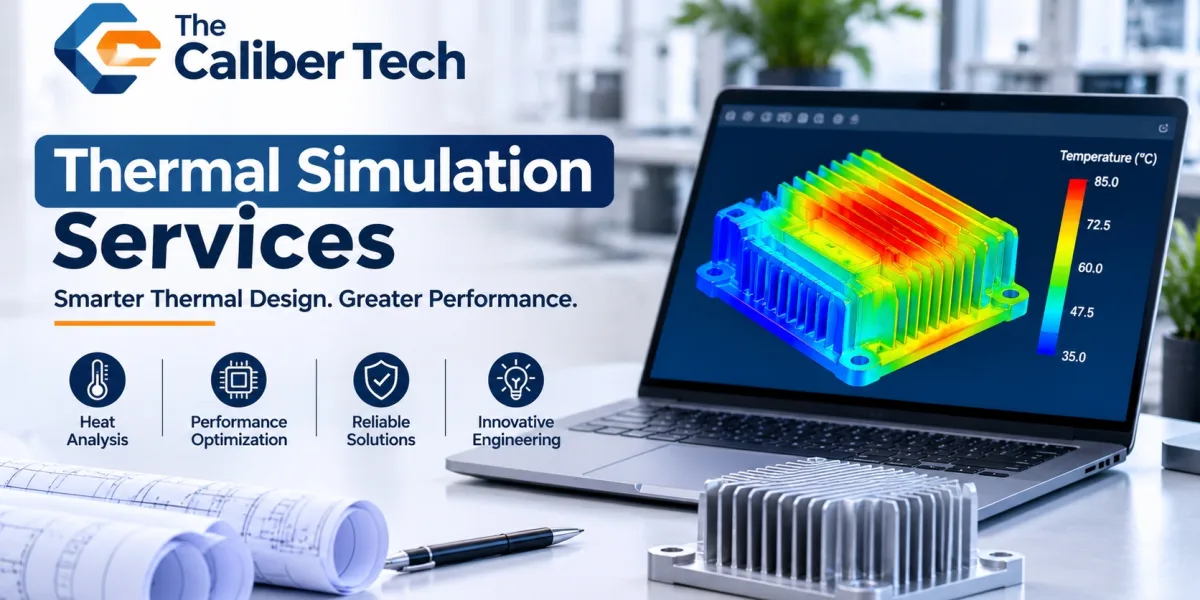
Heat management plays an important role in the performance, safety, and durability of modern products. Whether engineers are developing electronic equipment, automotive components, industrial machinery, or aerospace systems, controlling temperature is essential for preventing failures and maintaining consistent operation. Thermal simulation services help businesses understand how heat moves through different materials and components before a product is manufactured.
These services use computer-based engineering models to predict temperature distribution, heat transfer, and cooling performance under different operating conditions. Instead of depending only on physical prototypes, engineers can study potential thermal problems digitally and make improvements during the design process. This approach helps manufacturers reduce development expenses, improve product efficiency, and avoid costly design modifications after production begins.
What Are Thermal Simulation Services?
Thermal simulation services involve using engineering software and mathematical models to evaluate the thermal behavior of products, equipment, and complete systems. Engineers examine how heat is generated, transferred, stored, and released under specific environmental and operating conditions.
The analysis considers three primary heat transfer mechanisms:
-
Conduction: Heat travels through solid materials, such as metal components, plastic housings, and electronic circuit boards.
-
Convection: Heat moves between a surface and a surrounding fluid, such as air or liquid.
-
Radiation: Energy transfers through electromagnetic waves between surfaces without requiring direct contact.
Understanding these mechanisms allows engineers to identify areas where excessive heat may accumulate. They can then evaluate different materials, cooling arrangements, and structural modifications to improve thermal performance.
How Does the Thermal Simulation Process Work?
A successful thermal simulation requires accurate product information, suitable engineering assumptions, and careful interpretation of results.
1. Developing the Digital Model
The process usually begins with a three-dimensional CAD model of the product or system. Engineers import the design into simulation software and prepare its geometry for analysis.
The model includes important structural details, such as component dimensions, wall thicknesses, internal spaces, and connections. Unnecessary geometric details may be simplified to reduce computational requirements without affecting important thermal characteristics.
2. Assigning Material Properties
Every material behaves differently when exposed to heat. Engineers assign suitable thermal properties to each component.
These properties generally include:
-
Thermal conductivity
-
Specific heat capacity
-
Density
-
Surface emissivity
-
Temperature-dependent material characteristics
For example, copper is commonly used in heat transfer applications because of its high thermal conductivity. Plastic materials generally conduct heat less effectively, making their selection important when designing insulated housings or protective enclosures.
3. Defining Operating Conditions
Engineers establish the conditions under which the product will operate. These conditions may include internal heat generation, surrounding air temperature, airflow velocity, cooling liquid temperature, and external heating sources.
For an electric motor, the model may include heat generated by electrical resistance, mechanical losses, and surrounding environmental conditions.
Accurate boundary conditions are essential because unrealistic assumptions can produce misleading simulation results.
4. Performing Thermal Analysis
Once the model is prepared, engineers run the simulation to calculate temperature distribution and heat transfer.
Depending on the project, they may perform different types of analysis:
Steady-state thermal analysis: Determines temperature distribution when operating conditions remain relatively constant and the system reaches thermal equilibrium.
Transient thermal analysis: Examines temperature changes over time. It is useful for evaluating startup conditions, shutdown periods, heating cycles, and changing workloads.
5. Evaluating Results and Optimizing the Design
Simulation software produces visual and numerical results that help engineers understand the thermal behavior of a product.
Temperature contour maps, heat flux measurements, and temperature profiles can reveal areas that require improvement.
Engineers may modify component placement, increase ventilation, introduce additional cooling elements, or select alternative materials. The revised design can then be analyzed again to determine whether the changes improve performance.
Major Applications of Thermal Simulation Services
Thermal analysis is valuable in industries where temperature directly affects equipment operation and product reliability.
Electronics and Semiconductor Manufacturing
Electronic devices generate heat through electrical resistance and component activity. Processors, power modules, circuit boards, and semiconductor devices can experience performance problems when operating temperatures exceed their recommended limits.
Thermal simulation helps engineers evaluate heat sink designs, cooling fans, ventilation arrangements, and thermal interface materials.
It is particularly useful when developing compact electronic products because limited internal space makes heat removal more challenging.
Automotive and Electric Vehicle Engineering
Automotive systems contain several heat-producing components, including engines, electric motors, batteries, and power electronics.
Electric vehicle batteries require careful temperature management to maintain performance and support safe operation. Engineers use thermal analysis to evaluate battery pack temperature distribution, cooling channels, and heat transfer between individual cells.
The same approach can improve motor cooling, charging systems, and vehicle cabin temperature management.
Aerospace and Defense
Aircraft and aerospace equipment experience changing temperatures, demanding operating environments, and strict engineering requirements.
Thermal simulation helps engineers evaluate temperature variations in electronic systems, structural components, engines, and thermal protection systems.
It also supports the assessment of thermal stresses caused by temperature changes, helping engineers understand whether materials and components can withstand expected operating conditions.
Industrial Equipment and Manufacturing
Industrial machines often generate heat through friction, electrical losses, and continuous mechanical operation.
Thermal simulation can identify overheating risks in pumps, compressors, motors, hydraulic equipment, and manufacturing systems.
The findings help engineers improve cooling arrangements, reduce thermal stress, and maintain stable operating temperatures.
Building and HVAC Engineering
Thermal simulation also supports the design of energy-efficient buildings and climate control systems.
Engineers can examine heat transfer through walls, roofs, windows, and insulation materials. They can also evaluate indoor temperature distribution and cooling requirements under different environmental conditions.
This information helps improve building energy performance and occupant comfort.
Practical Benefits of Thermal Simulation Services
Businesses use thermal analysis because it provides useful engineering information before expensive manufacturing decisions are made.
Better Product Reliability
Excessive heat can damage components, affect material properties, and shorten equipment lifespan.
Simulation identifies potential overheating areas during the design stage, allowing engineers to make corrections before the product enters production.
Reduced Engineering and Manufacturing Costs
Developing physical prototypes and conducting repeated laboratory tests can be expensive.
Thermal simulation allows engineers to compare different design options digitally. This can reduce unnecessary prototypes and help identify the most promising solutions before physical testing begins.
More Effective Cooling Systems
Cooling systems must remove enough heat without creating unnecessary energy consumption, weight, or manufacturing complexity.
Simulation helps engineers compare fan configurations, heat sinks, ventilation openings, and liquid cooling arrangements. They can select solutions based on actual thermal requirements rather than assumptions.
Improved Energy Efficiency
Heat losses can reduce the efficiency of industrial equipment and electrical systems.
By studying temperature distribution and heat transfer, engineers can identify opportunities to improve insulation, reduce unwanted heat generation, and optimize cooling performance.
Faster Product Development
Digital testing makes it easier to evaluate design modifications without manufacturing a new prototype for every change.
This can shorten engineering development cycles and allow businesses to identify potential problems earlier.
Common Challenges in Thermal Simulation
Despite its advantages, thermal simulation requires careful technical preparation.
Incorrect Material Information
Unreliable material properties can affect predicted temperatures and heat transfer rates. Engineers should use verified material data and account for temperature-dependent properties when necessary.
Complex Product Geometry
Products containing narrow channels, thin walls, and multiple internal components can be difficult to model accurately.
Engineers must simplify geometry carefully while preserving features that significantly influence thermal behavior.
Boundary Condition Errors
Incorrect heat generation rates, airflow assumptions, or environmental temperatures can lead to unrealistic results.
Understanding the actual operating environment is essential for producing useful predictions.
Simulation Validation
A digital model does not automatically guarantee real-world accuracy. Engineers should compare important simulation results with physical measurements whenever practical.
Testing helps identify differences between predicted and actual performance and allows the model to be improved.
How to Select a Thermal Simulation Service Provider
Choosing the right engineering partner is important for obtaining meaningful results.
Consider these factors before making a decision:
-
Engineering experience: Look for professionals with knowledge of heat transfer, thermal analysis, and related engineering disciplines.
-
Industry expertise: Select a provider familiar with your product type and its operating requirements.
-
Simulation capabilities: Confirm that the company can perform the required steady-state, transient, or coupled thermal analysis.
-
Technical reporting: Reports should clearly explain assumptions, material properties, temperature results, and recommended improvements.
-
Design optimization: A good provider should offer practical recommendations rather than simply delivering simulation images.
-
Validation approach: Ask how simulation results are checked against physical testing or established engineering data.
Frequently Asked Questions (FAQs)
1. What is the main purpose of thermal simulation services?
Their main purpose is to predict heat transfer and temperature distribution in products and systems. Engineers use the results to prevent overheating, improve cooling arrangements, and evaluate product reliability.
2. Which software is used for thermal simulation?
Common engineering tools include ANSYS, Siemens Simcenter, COMSOL Multiphysics, and Autodesk simulation solutions. The appropriate software depends on the project, analysis requirements, and engineering workflow.
3. What is the difference between thermal analysis and CFD?
Thermal analysis focuses on heat transfer and temperature distribution. Computational Fluid Dynamics (CFD) studies fluid movement and related physical processes. CFD can also model convective heat transfer and is frequently combined with thermal analysis.
4. Can thermal simulation identify overheating problems?
Yes. It can identify potential thermal hotspots, excessive component temperatures, and insufficient cooling performance. Engineers can use these findings to improve the product design before manufacturing.
5. Are thermal simulations a replacement for physical testing?
No. Simulation reduces the need for repeated physical prototypes, but testing remains important for validating results. Combining digital analysis with experimental testing generally provides greater confidence in product performance.
Conclusion
Effective heat management is essential for developing reliable and efficient products. Poor temperature control can reduce performance, damage components, and increase maintenance requirements. Thermal simulation services provide engineers with a practical way to understand heat transfer, identify potential problems, and improve product designs before manufacturing.
From electronics and electric vehicles to aerospace systems and industrial machinery, thermal analysis supports better engineering decisions across different industries. By combining accurate digital models, suitable material properties, and realistic operating conditions, businesses can develop more effective cooling solutions, improve product reliability, and control development costs.


