
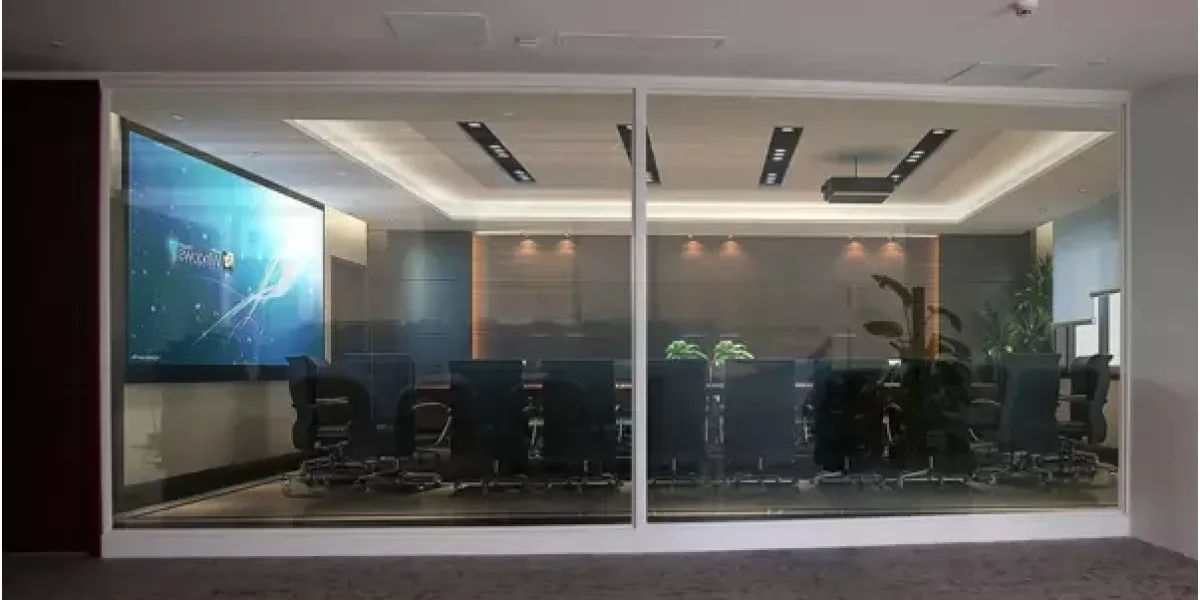
Modern offices are increasingly designed around glass partitions to create bright, open, and flexible working environments. While glass improves natural lighting and visual connectivity, it can also create privacy challenges in meeting rooms, executive offices, phone booths, and other spaces where confidential conversations take place. Smart film offers a practical way to balance transparency and privacy without sacrificing the advantages of glass architecture.
However, choosing smart film for an office is not simply about selecting a product. Different rooms have different privacy requirements, switching frequencies, lighting conditions, and control needs. Understanding these differences helps businesses develop a more effective smart partition system.
Why Smart Film Is Ideal for Modern Office Partitions
Switchable smart film uses liquid crystal technology to change the appearance of glass between transparent and opaque states. When electrical power is applied, the film becomes transparent. When power is switched off, it scatters light and turns opaque, providing visual privacy.
Unlike conventional blinds or curtains, smart film allows privacy to be controlled instantly without additional mechanical structures. It helps preserve natural light, maintain a minimalist interior design, and create flexible spaces that adapt to different activities.
For offices with glass meeting rooms, shared workspaces, and client-facing areas, smart film for office partitions offers a versatile solution for balancing openness with privacy.
Choosing Smart Film for Different Office Spaces
Different office areas require different smart film configurations.
Boardrooms and conference rooms: These spaces need professional appearance, consistent optical performance, and privacy during confidential discussions. Laminated smart film is often suitable for new installations, while self-adhesive film can be used for existing glass partitions. Projection requirements should also be considered when meeting rooms use glass as presentation surfaces.
Open-plan offices: Smart film can create temporary visual separation without permanently blocking daylight. For larger installations, zone-based control allows multiple panels to switch together, making operation easier for employees and facilities teams.
Phone booths and focus rooms: These spaces may switch between transparent and opaque states many times throughout the day. Switching frequency, driver reliability, and power supply performance should be carefully evaluated to support frequent operation.
Executive offices: Smart film helps executives maintain visual contact with the office while protecting private conversations. Independent control allows privacy to be activated whenever necessary without closing off the space permanently.
HR, legal, and finance rooms: Confidentiality is a priority in rooms handling employee records, contracts, financial information, or sensitive meetings. A clearly defined opaque state helps communicate that the room is being used for a private session.
Reception and branding areas: Smart film can combine privacy functions with logos, patterns, decorative graphics, or projection applications. These design elements should be planned during film production to ensure they align with panel dimensions and electrical layouts.
Self-Adhesive Smart Film vs. Laminated Smart Film
One of the most important decisions in office partition projects is whether to install smart film on existing glass or incorporate it into newly manufactured glass panels.
Self-adhesive smart film is applied directly to the interior surface of existing glass. It is particularly useful for renovations, leased offices, and projects where replacing glass would be expensive or disruptive. Installation can often be completed without major changes to the partition structure.
Laminated smart film is integrated into the glass interlayer during manufacturing. This construction protects the switchable layer and offers a more integrated finish. It is suitable for new construction, complete office fit-outs, and projects requiring specific glass safety or structural characteristics.
Many offices benefit from combining both options. New boardroom glass may use laminated construction, while existing phone booths and internal meeting rooms can be upgraded with self-adhesive film.
Control Systems, Power Supply, and Installation Planning
Smart film is both a glazing material and an electrical system. Control methods may include wall switches, remote controls, centralized zone switching, or integration with building automation and meeting-room systems.
Before installation, the project team should determine which panels operate independently and which switch together. Meeting rooms may require individual controls, while large open-plan areas may benefit from grouped switching and facilities management overrides.
The default state during power loss should also be specified. Privacy-sensitive spaces commonly require an opaque state when power is unavailable, but the actual behavior must be confirmed with the selected film and controller.
Wiring routes, busbar positions, frame details, power supply capacity, and edge sealing should be coordinated before installation. Proper planning helps avoid visible wiring, inconsistent switching, and preventable maintenance issues.
Key Factors for Smart Film Performance and Durability
When evaluating smart film for office partitions, buyers should consider optical uniformity, transparency, privacy performance, switching speed, power requirements, and expected service life.
High-touch partitions, such as phone booths and desk dividers, require particular attention to edge protection, cleaning procedures, and moisture exposure. For projection applications, the film should be specifically evaluated for projected image quality under the actual room lighting conditions.
Color options, including white, grey, and tinted smart film, can influence interior appearance and transmitted light. However, film color alone does not determine privacy performance. Both transparent and opaque states should be evaluated on representative finished panels before final approval.
Why Work with an Experienced Smart Film Supplier?
Choosing a supplier with experience in smart film manufacturing, glass integration, and control systems can simplify project coordination. A qualified supplier should be able to provide technical specifications, samples, installation guidance, power supply recommendations, and evidence of performance under relevant test conditions.
For multi-room office projects, compatibility between film, glass, drivers, controls, and wiring is particularly important. Working with a supplier capable of coordinating these elements helps reduce installation uncertainty and supports more consistent project outcomes.
Explore smart film and office partition solutions to learn more about switchable privacy technology for commercial interiors.
Conclusion
Smart film provides offices with a flexible way to manage privacy while retaining the openness, daylight, and modern appearance of glass partitions. From boardrooms and executive offices to phone booths, reception areas, and open-plan workspaces, the right solution depends on room function, switching frequency, installation conditions, and control requirements.
By evaluating these factors early and selecting the appropriate self-adhesive or laminated construction, businesses can develop smarter office environments that combine privacy, functionality, and architectural design. A well-planned smart film installation is not just an upgrade to glass partitions but an investment in a more adaptable workplace.


