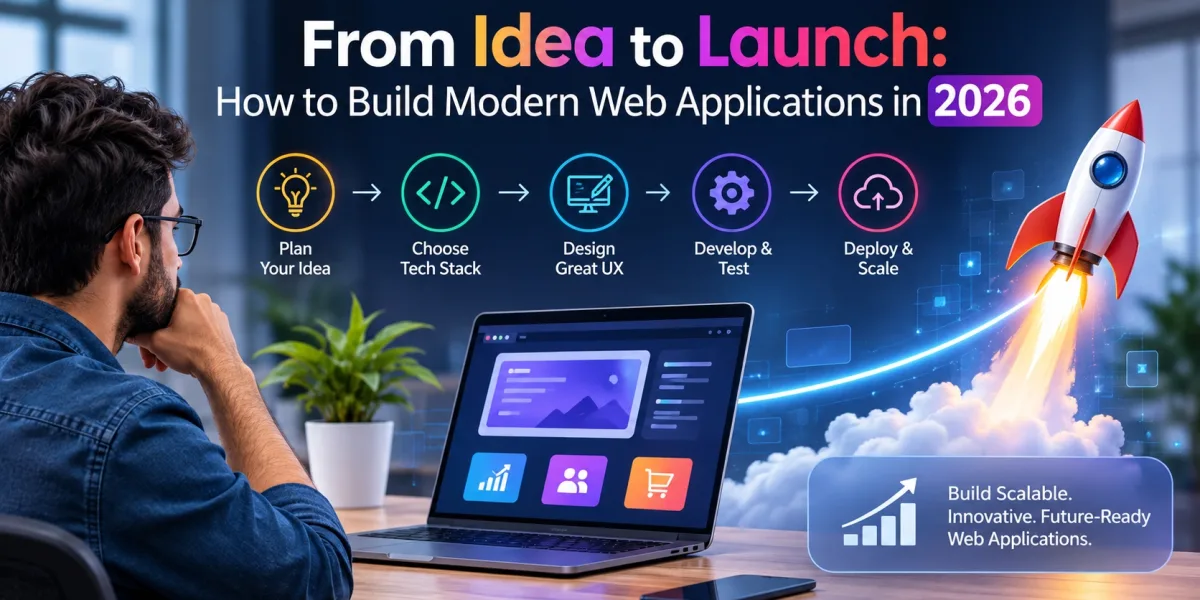
Building a modern web application in 2026 is about more than writing code or creating an attractive interface. Businesses need applications that are fast, scalable, secure, mobile-friendly, and intelligent enough to meet changing customer expectations.
From startups launching their first MVP to enterprises modernizing legacy systems, web application development has become a strategic investment. Technologies such as AI-powered development, cloud computing, progressive web apps (PWAs), API integrations, and modern JavaScript frameworks are changing how businesses build and scale digital products.
But how do you turn an idea into a successful web application?
Let's explore the complete web application development process, from initial planning to launch, and the technologies businesses should consider in 2026.
1. Start With a Clear Business Idea and Strategy
Every successful web application begins with a problem worth solving. Before choosing a technology stack or hiring developers, define what your application should achieve.
Start by identifying:
-
Target audience: Who will use your application?
-
Business objectives: What problem will it solve?
-
Core features: What functionality is essential?
-
Market research: What are competitors offering?
-
Revenue model: How will the application generate value?
For startups, building a Minimum Viable Product (MVP) is a practical way to validate an idea without investing heavily in unnecessary features.
A clear development strategy helps reduce project risks, control costs, and create a product aligned with actual market demand.
2. Choose the Right Web Application Development Approach
Not every business needs the same type of web application. The right approach depends on your business model, target audience, performance requirements, and long-term growth plans.
Here are some popular web application types:
-
Single Page Applications (SPAs): Deliver faster, interactive user experiences without reloading entire pages.
-
Progressive Web Applications (PWAs): Provide app-like experiences through web browsers, including selected offline capabilities.
-
Enterprise Web Applications: Support complex business operations, workflows, and integrations.
-
AI-Powered Web Applications: Use artificial intelligence for automation, personalization, recommendations, and intelligent assistance.
-
SaaS Applications: Deliver cloud-based software through subscription-based business models.
Choosing the right application architecture early helps businesses avoid expensive redevelopment as user demand increases.
3. Select a Modern Technology Stack
Technology selection directly impacts application performance, scalability, security, and maintenance.
In 2026, modern web application development relies on flexible frameworks, cloud infrastructure, AI services, and secure backend technologies.
Here are some widely adopted technologies:
|
Development area |
Popular technologies |
|---|---|
|
Frontend development |
React, Next.js, Angular, Vue.js |
|
Backend development |
Node.js, Python, Java, .NET |
|
Database |
PostgreSQL, MongoDB, MySQL |
|
Cloud infrastructure |
AWS, Microsoft Azure, Google Cloud |
|
UI/UX design |
Figma, Adobe XD |
|
API development |
REST APIs, GraphQL |
|
AI integration |
Commercial LLM APIs, LangChain, AI/ML frameworks |
|
DevOps |
Docker, Kubernetes, GitHub Actions |
There is no universally best technology stack. The right combination depends on your application requirements, development budget, team expertise, and scalability goals.
Business insight: Avoid selecting technologies simply because they are trending. Choose tools that support your application's long-term business objectives.
4. Focus on UI/UX Design and User Experience
A technically advanced application can still fail if users struggle to navigate it.
Modern web application design should prioritize simplicity, accessibility, responsiveness, and usability.
Important UI/UX considerations include:
-
Mobile-first and responsive web design.
-
Simple navigation and intuitive user journeys.
-
Fast-loading pages and optimized interfaces.
-
Consistent branding and visual elements.
-
Accessible design for different user needs.
-
Clear calls to action and conversion-focused layouts.
Before development begins, create wireframes and interactive prototypes to visualize how users will interact with the application.
A user-centered design approach reduces usability issues and improves customer engagement, retention, and conversion rates.
5. Build Scalable and Secure Web Application Architecture
As your business grows, your application must handle increasing traffic, data, and transactions without compromising performance.
This makes application architecture one of the most important parts of custom web application development.
Consider these essential elements:
Scalable backend architecture: Build backend systems that can support increasing workloads and changing business requirements.
Cloud-based infrastructure: Use cloud platforms to improve resource management, availability, and scalability.
API integrations: Connect payment gateways, CRM systems, ERP platforms, and third-party services.
Database optimization: Organize and manage application data efficiently.
Application security: Implement authentication, authorization, data encryption, secure APIs, and regular security testing.
Businesses should also follow secure development practices and consider relevant data protection requirements from the beginning.
A scalable architecture makes future upgrades easier and reduces the risk of expensive technical changes.
6. Integrate AI and Automation Into Web Applications
Artificial intelligence is becoming an important part of modern web application development.
Instead of treating AI as an additional feature, businesses can integrate intelligent capabilities directly into application workflows.
Some practical AI-powered web application features include:
-
AI chatbots for customer support.
-
Personalized product and content recommendations.
-
AI-powered search and intelligent filtering.
-
Predictive analytics for business decisions.
-
Automated data processing and workflows.
-
AI voice assistants and virtual agents.
-
Generative AI features for content and document creation.
For example, an eCommerce application can use AI recommendation engines to suggest relevant products, while a SaaS platform can integrate AI assistants to automate repetitive tasks.
However, AI integration should solve a genuine business problem. Data privacy, model accuracy, infrastructure costs, and human oversight must also be considered.
7. Test, Deploy, and Launch Your Web Application
Development is not complete when the application runs successfully on a developer's computer. Thorough testing is essential before launching it to real users.
A comprehensive web application testing process should include:
-
Functional testing: Verify that all features work correctly.
-
Performance testing: Evaluate speed, responsiveness, and traffic handling.
-
Security testing: Identify vulnerabilities and potential risks.
-
Compatibility testing: Check functionality across browsers and devices.
-
Usability testing: Understand how real users interact with the application.
Once testing is complete, deploy the application using a reliable cloud infrastructure or hosting environment.
Tools such as Docker, Kubernetes, and CI/CD pipelines can help streamline deployment and future updates.
After launch, continuously monitor application performance, fix issues, collect user feedback, and release improvements.
Remember: Launching your application is the beginning of its growth, not the end of development.
8. Maintain and Scale Your Application for Long-Term Growth
A modern web application needs continuous maintenance to remain secure, competitive, and relevant.
Post-launch activities should include:
-
Regular security updates and bug fixes.
-
Database and performance optimization.
-
Feature enhancements based on user feedback.
-
Infrastructure monitoring and scaling.
-
SEO improvements and Core Web Vitals optimization.
-
Analytics tracking and conversion monitoring.
Businesses that invest in continuous improvement can adapt faster to changing customer expectations and technology trends.
Why Choose Albiorix Technology for Modern Web Application Development?
Turning an innovative idea into a successful digital product requires more than technical execution. It requires the right development strategy, technology expertise, and understanding of business goals.
Albiorix Technology helps startups, growing businesses, and enterprises transform ideas into scalable digital solutions through custom web application development.
From MVP development and UI/UX design to full-stack engineering, AI integration, API development, and cloud-based solutions, the team focuses on building applications that support real business requirements.
Whether you are planning a new SaaS platform, modernizing an existing application, or building an AI-powered web solution, the right development partner can help you move from concept to launch with confidence.
Have a web application idea? Let's turn it into a scalable digital product.
Final Thoughts
Building a modern web application in 2026 requires a combination of strategic planning, the right technology stack, user-focused design, scalable architecture, and continuous optimization.
The most successful applications are not necessarily those with the most features. They are the ones that solve real problems, deliver excellent user experiences, and adapt as businesses grow.
Whether you are a startup founder or an enterprise decision-maker, investing in the right web application development strategy today can create long-term business value.