
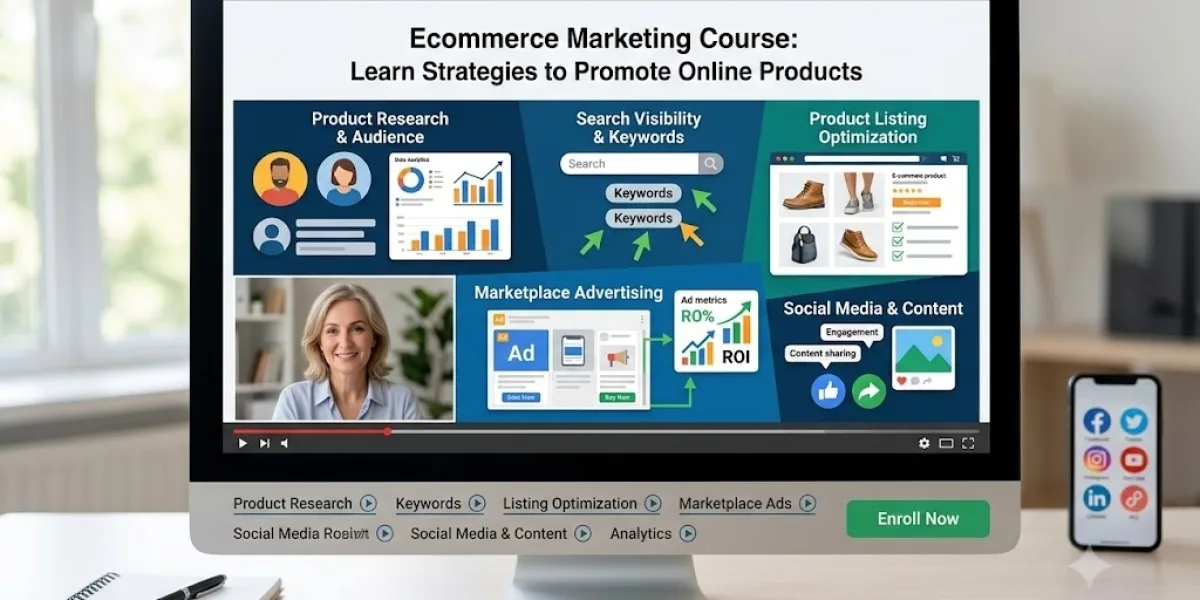
Online businesses operate in a competitive environment where attracting customers requires more than simply uploading products to a website or marketplace. Sellers need to understand customer behavior, product positioning, search visibility, advertising, and promotional planning to reach the right audience. Effective marketing connects these activities and helps businesses communicate the value of their products.
An Ecommerce Marketing Course introduces learners to the strategies used to promote products online. It can be useful for students, aspiring marketers, entrepreneurs, and business owners who want to understand how digital marketing supports e-commerce growth.
What Is E-Commerce Marketing?
E-commerce marketing involves promoting products and online stores through digital channels. These channels may include online marketplaces, search engines, social media platforms, email campaigns, websites, and paid advertising networks.
Each channel serves a different purpose. Search optimization helps potential customers discover relevant products, advertising can increase exposure, and useful content helps shoppers understand product features. A well-planned marketing approach combines suitable methods according to the business's goals and audience.
Why Learn E-Commerce Marketing?
Online shoppers often compare several products before making a decision. They may evaluate prices, specifications, photographs, customer reviews, delivery options, and seller information. Businesses therefore need to make their products easy to discover and their value easy to understand.
Marketing knowledge helps professionals plan promotional activities instead of relying entirely on discounts or random advertising. It also provides a framework for measuring results and improving campaigns over time.
Core Topics Covered in an Ecommerce Marketing Course
1. Product Research and Audience Analysis
Before promoting a product, marketers need to understand who might buy it and what those customers value. Product research can involve examining demand, competitor offerings, pricing, product features, and customer preferences.
Audience analysis helps businesses identify the problems their products solve and the information potential buyers need. These insights can guide product messaging, advertising choices, and promotional content.
2. Keyword Research and Search Visibility
Keywords connect customer searches with relevant product information. Researching search phrases helps marketers understand how people describe products, which features matter to buyers, and how search intent varies.
Relevant keywords can be incorporated into product titles, descriptions, website content, and advertising campaigns where appropriate. The objective is to provide useful, accurate information rather than repeating phrases unnaturally.
3. Product Listing Optimization
A product listing should answer the questions a potential customer is likely to ask. Clear titles, informative descriptions, quality images, accurate specifications, and transparent pricing make product pages easier to evaluate.
Listing optimization also involves checking whether the information follows the marketplace's requirements. Consistent and accurate content can reduce confusion and improve the overall shopping experience.
4. Marketplace Advertising
Many e-commerce platforms provide advertising options that allow sellers to promote selected products. Understanding these tools is useful for planning campaigns and managing promotional budgets.
Important concepts include audience or keyword targeting, campaign structure, bids, budgets, clicks, conversions, and advertising costs. Marketers should review campaign performance regularly rather than assuming that every advertisement will produce profitable sales.
5. Social Media and Content Marketing
Social media can introduce products to audiences who may not be actively searching on a marketplace. Product demonstrations, short videos, informative posts, tutorials, and customer-focused content can help communicate product benefits.
Content should match the interests of the intended audience. Educational or useful material often provides more value than repeatedly publishing direct sales messages.
Planning an Effective Marketing Campaign
A successful campaign begins with a clearly defined objective. A business might want to increase product awareness, attract qualified website visitors, promote a new product, or improve sales of an existing item.
Once the goal is established, marketers can select suitable channels, define their audience, prepare promotional materials, allocate a budget, and determine how results will be measured.
For example, a campaign promoting a newly launched product may focus on awareness and initial traffic. A campaign for an established product may concentrate on conversion rates and advertising efficiency. Different objectives require different performance measures.
Understanding Marketing Analytics
Data analysis helps marketers understand what happens after a campaign goes live. Useful metrics may include impressions, clicks, click-through rate, conversion rate, cost per click, advertising spend, revenue, and return on advertising spend.
These measurements should be interpreted in context. A campaign generating many clicks may still be ineffective if those visitors rarely purchase. Similarly, strong sales do not automatically mean a campaign is profitable if advertising and other costs are too high.
Learning to interpret performance data allows marketers to identify opportunities, test improvements, and make more informed decisions.
Common Mistakes in E-Commerce Marketing
One common mistake is targeting a broad audience without considering product relevance. Another is sending visitors to listings that contain incomplete descriptions, unclear images, or inconsistent information.
Businesses may also spend money on advertising without setting measurable goals or monitoring campaign results. Excessive keyword use and unsupported product claims can further weaken the quality of marketing content.
Regular evaluation, accurate information, and customer-focused communication can help avoid these problems.
Who Can Benefit From This Course?
An ecommerce marketing course may be suitable for students interested in digital commerce, professionals looking to expand their marketing knowledge, online sellers seeking better promotional methods, and entrepreneurs planning to launch products through marketplaces.
It can also complement broader digital marketing knowledge by focusing on the specific challenges of selling products online, including product discovery, listing quality, marketplace advertising, and conversion performance.
How to Select the Right Training Program
Before enrolling, review the syllabus to determine whether it includes relevant subjects such as keyword research, product listing optimization, campaign planning, marketplace advertising, and analytics. Practical assignments can help learners apply these concepts rather than relying exclusively on theory.
Check the trainer's experience, learning format, course duration, project work, and support available during the program. If certification or placement assistance is advertised, confirm the specific terms and conditions before making a decision.
Conclusion
E-commerce marketing brings together research, product content, advertising, audience understanding, and performance measurement. Businesses need these elements to communicate product value and make informed promotional decisions in competitive online markets.
By studying an Ecommerce Marketing Course, learners can build a foundation in the techniques used to promote products across digital channels. Combining structured learning with practical exercises and regular analysis can help develop useful skills for online business and marketing roles.


