
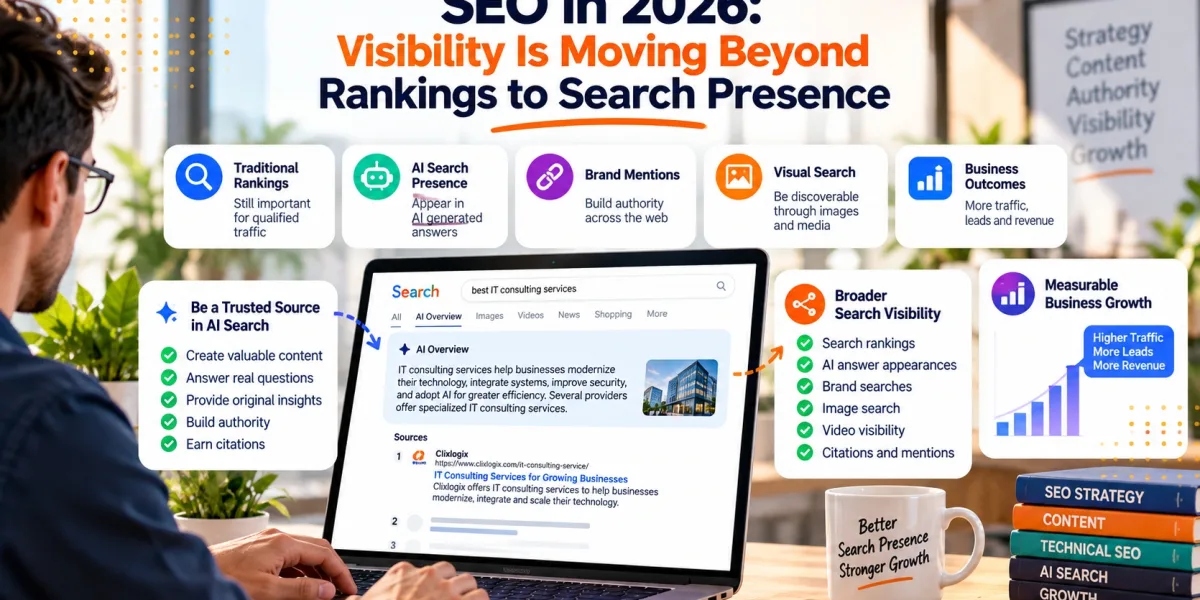
SEO reporting used to revolve around a familiar set of metrics: keyword rankings, organic impressions, clicks, traffic, and conversions.
Those metrics still matter in 2026. Search behavior now reaches far beyond a conventional results page.
People increasingly find information through AI generated responses, conversational search, visual discovery, branded searches, featured answers, videos, and other search experiences. This is changing how businesses should think about AI Powered SEO Services.
The objective is becoming broader. A business needs to know whether its information can be found, understood, referenced, trusted, and connected to measurable business outcomes.
Rankings Still Matter
Ranking position has not suddenly become irrelevant.
A strong organic position can still create qualified traffic and commercial opportunities.
The limitation is that a ranking report shows only one part of search visibility.
A business may also gain value when its content:
- Appears as a source in an AI generated response
- Supports a branded search later
- Appears through image or visual search
- Answers a question directly
- Leads users toward another page on the website
- Influences a buying decision before a click occurs
SEO measurement needs to account for these wider outcomes.
Content Needs to Be Easy to Understand
Search systems work better when pages communicate their subject clearly.
That begins with basic content structure.
A useful page should contain:
- A clear primary topic
- Descriptive headings
- Direct answers
- Relevant supporting detail
- Clear entities and terminology
- Natural internal links
- Original information where possible
Vague headings make a page harder to interpret.
For example:
Important Things to Know
provides little context.
A heading such as:
Why CRM Data Quality Affects AI Search Recommendations
communicates much more clearly.
Good structure helps both readers and search systems understand the page.
Individual Sections Need More Value
Long form content often covers several related questions.
Search systems may retrieve one specific passage instead of relying on the entire article.
That means individual sections should provide useful information on their own.
A strong section usually follows a simple structure:
Specific heading → Direct explanation → Supporting detail → Example
This also improves readability.
Readers can scan the page and quickly identify the information relevant to their problem.
Original Information Creates Source Value
AI can reproduce generic explanations very quickly.
That makes original information increasingly valuable.
Businesses have information that generic content generators do not automatically possess.
Examples include:
- Project experience
- Internal research
- Customer questions
- Original data
- Screenshots
- Implementation lessons
- Product comparisons
- Expert commentary
- Process diagrams
- Testing results
This material gives a page a stronger reason to exist.
Consider two statements.
The first says:
Website migrations require careful planning.
The second explains:
Before migrating a multi location website, map every high traffic landing page to its new destination and validate redirects against historical organic traffic.
The second statement gives the reader something actionable.
Specific knowledge makes content more useful.
SEO Content Should Be Worth Referencing
A helpful question when reviewing an article is:
Would another person have a reason to reference this page?
A page filled with broad statements may rank temporarily while providing little source value.
Pages become easier to reference when they include:
- Clear definitions
- Original observations
- Specific recommendations
- Useful examples
- Data
- Comparison criteria
- Step by step processes
This matters as search experiences increasingly summarize information from several sources.
The website needs to contribute something worth carrying forward.
Brand Mentions Matter Too
Modern search visibility is not limited to links.
Search systems also encounter brands through articles, reviews, social content, directories, videos, discussions, and other websites.
Consistent brand mentions help create context around what a company does.
This makes digital PR, thought leadership, expert commentary, social publishing, and high quality third party coverage useful parts of broader search strategy.
The objective is not simply creating mentions.
The surrounding context should accurately connect the brand with relevant expertise.
Visual Search Creates Another Discovery Path
Images can contribute to search visibility when they actually communicate information.
Useful visual assets include:
- Product screenshots
- Architecture diagrams
- Process illustrations
- Comparison graphics
- Charts
- Original photography
- Annotated interfaces
Generic stock photography may improve page appearance without adding much informational value.
A strong visual should help answer a question or explain something faster than text alone.
Alt text, descriptive filenames, surrounding context, and image quality still support search understanding.
Internal Linking Should Follow Topic Relationships
Internal links help readers move naturally between related information.
They also help search engines understand how topics connect across a website.
For example, an article discussing AI application architecture may naturally connect to pages about:
- AI development
- Software testing
- Enterprise software
- IT consulting
- Data integration
The link should appear where the destination genuinely helps the reader.
Descriptive anchor text also provides more context than generic phrases such as “read more.”
Technical SEO Still Supports AI Search
New AI search experiences do not remove traditional technical requirements.
Pages still need to be:
- Crawlable
- Indexable
- Fast
- Mobile friendly
- Properly canonicalized
- Internally connected
- Accessible
- Structurally clear
Search systems cannot confidently use information they cannot reliably access.
Technical SEO therefore remains part of every modern search strategy.
SEO Reporting Needs Broader Metrics
A useful SEO report in 2026 should look beyond rankings alone.
Traditional Search
- Rankings
- Impressions
- Clicks
- CTR
- Organic sessions
Search Presence
- AI answer appearances
- Source citations
- Brand mentions
- Visual search visibility
- Branded search demand
User Quality
- Engagement
- Key page visits
- Returning visitors
- Content assisted journeys
Business Impact
- Qualified leads
- Opportunities
- Sales
- Assisted conversions
- Revenue contribution
This gives decision makers a clearer understanding of what organic visibility is producing.
AI Can Help SEO Teams Work Faster
AI can support many parts of SEO work.
It can help with:
- Search intent analysis
- Content research
- Topic clustering
- Content briefs
- Internal linking ideas
- Schema preparation
- Content audits
- SERP analysis
- Reporting summaries
The strongest results still depend on reliable source information and human review.
Publishing more content without adding more value simply creates more pages competing for attention.
SEO Is Becoming a Visibility System
The role of SEO is expanding.
Businesses still need to rank.
They also need content that can be understood by AI systems, cited as a useful source, found through different search formats, connected to a recognizable brand, and tied back to commercial outcomes.
That makes SEO in 2026 less about chasing one position for one keyword.
The stronger objective is sustained search presence across the places where customers research, compare, and make decisions.


