
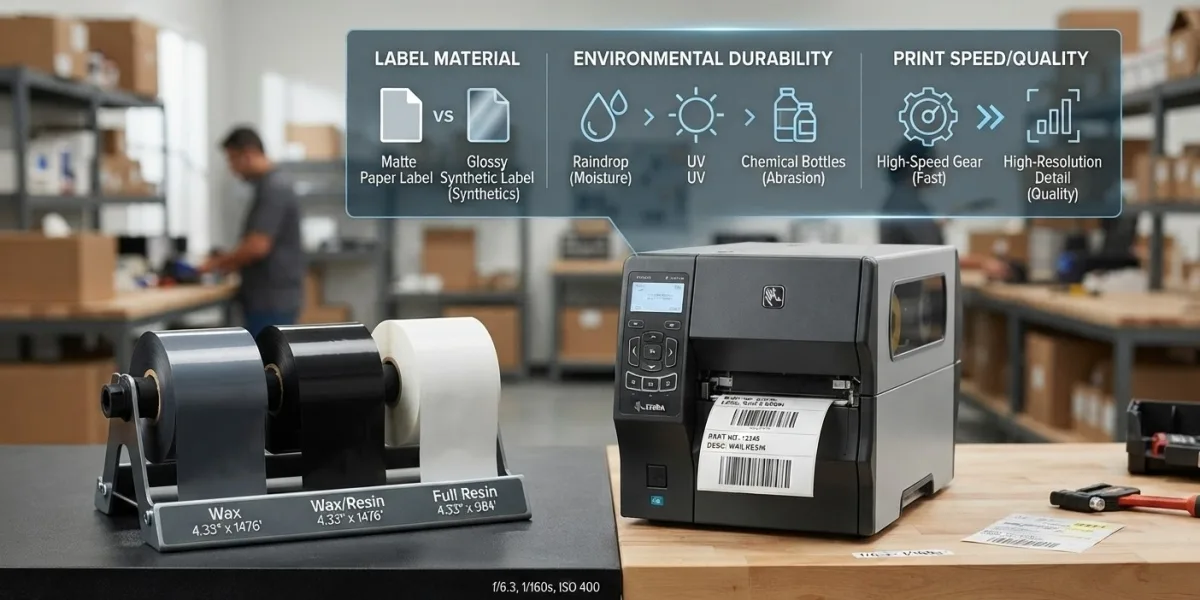
Choosing the right barcode ribbon is an important decision for businesses that use thermal transfer printing. A barcode ribbon directly affects print quality, label durability, scanning performance, and overall printing costs. Using the wrong ribbon can lead to faded barcodes, poor adhesion, smudging, printhead wear, and labels that become difficult to scan.
For businesses that depend on accurate product identification, inventory management, shipping, and asset tracking, selecting the right printing supplies is essential. Pointus Solutions provides barcode and printing solutions designed to support different business requirements, while businesses can explore Shop Barcode and Printing Products options to find suitable barcode printing supplies.
This guide explains the main types of barcode ribbons, how they work, and the factors businesses should consider before choosing one.
Table of Contents
- What Is a Barcode Ribbon?
- Why Is Choosing the Right Ribbon Important?
- Types of Barcode Ribbons
- Wax Barcode Ribbons
- Wax-Resin Barcode Ribbons
- Resin Barcode Ribbons
- How to Choose the Right Barcode Ribbon
- Consider the Label Material
- Consider the Printing Environment
- Check Printer Compatibility
- Consider Print Speed and Quality
- Think About Label Durability
- How the Right Ribbon Can Reduce Printing Costs
- Common Barcode Ribbon Selection Mistakes
- FAQs
- Conclusion and CTA
What Is a Barcode Ribbon?
A barcode ribbon is a coated material used with a thermal transfer barcode printer to create printed information on labels and other media.
During printing, the printer's printhead applies controlled heat to the ribbon. The coating transfers from the ribbon onto the label material, creating text, barcodes, graphics, and other information.
Barcode ribbons are commonly available in different formulations, with the three main categories being:
- Wax
- Wax-resin
- Resin
Each type is designed for different printing requirements. The correct choice depends on the label material, application, environmental conditions, and required durability.
Why Is Choosing the Right Ribbon Important?
A barcode ribbon is more than just a consumable printing supply. It can directly influence the quality and reliability of your labels.
Using the right ribbon can help businesses achieve:
- Clear and readable barcodes
- Better scanning performance
- Improved resistance to smudging
- Longer-lasting labels
- Better print quality
- Reduced printing problems
- Improved printhead protection
- More consistent production
On the other hand, selecting an unsuitable ribbon can result in poor-quality prints and unnecessary replacement costs.
For example, a basic wax ribbon may work well for short-term warehouse labels but may not be suitable for labels exposed to chemicals, moisture, abrasion, or outdoor conditions.
Types of Barcode Ribbons
Understanding the major ribbon types is the first step toward making the right choice.
1. Wax Ribbons
Wax ribbons are commonly used for general-purpose applications. They are typically suitable for printing on paper-based labels.
They can be a practical choice for applications such as:
- Product identification
- Retail labels
- Inventory labels
- Shipping labels
- General warehouse labeling
Wax ribbons are generally economical and work well when labels do not need to withstand harsh environmental conditions.
2. Wax-Resin Ribbons
Wax-resin ribbons combine characteristics of wax and resin. They generally provide better durability than standard wax ribbons while remaining suitable for many everyday applications.
They can be useful when businesses require better resistance to:
- Smudging
- Scratching
- Moderate moisture
- Handling
- General wear
Wax-resin ribbons are often a versatile option for businesses that need a balance between cost and durability.
3. Resin Ribbons
Resin ribbons are designed for demanding applications where labels need high durability.
They can be appropriate for labels exposed to conditions such as:
- Chemicals
- Abrasion
- Moisture
- High temperatures
- Outdoor environments
- Frequent handling
Resin ribbons are commonly used with synthetic label materials and can produce highly durable prints when properly matched with the label and printer.
How to Choose the Right Barcode Ribbon
There is no single barcode ribbon that is ideal for every business. The right choice depends on several factors.
1. Identify Your Label Material
The first thing to consider is the material you are printing on.
Paper labels may work well with wax or wax-resin ribbons, depending on the application. Synthetic materials such as polyester or polypropylene may require a resin-based ribbon for improved durability.
Before purchasing a ribbon, identify whether your labels are:
- Coated paper
- Uncoated paper
- Polypropylene
- Polyester
- Synthetic material
- Specialty label stock
Matching the ribbon to the label material helps produce better print quality and adhesion.
2. Consider the Printing Environment
Think about where your barcode labels will be used.
For indoor applications with limited exposure to moisture or abrasion, a wax ribbon may be sufficient.
However, labels used in manufacturing facilities, warehouses, healthcare environments, cold storage areas, or outdoor locations may require more durable ribbon technology.
Consider whether the label will be exposed to:
- Water
- Dust
- Chemicals
- Sunlight
- Heat
- Cold temperatures
- Frequent handling
- Friction or scratching
The more demanding the environment, the more important ribbon selection becomes.
3. Check Printer Compatibility
Not every ribbon works with every thermal transfer printer.
Before purchasing a ribbon, check your printer's specifications and determine:
- Ribbon width
- Ribbon length
- Core size
- Ribbon winding direction
- Printer model compatibility
- Maximum print width
Some printers support specific ribbon configurations, so checking compatibility beforehand can prevent printing problems.
4. Consider Print Speed
Businesses that print thousands of labels every day need to consider printing speed.
Some applications require high-speed printing without sacrificing barcode readability. The ribbon should be capable of producing consistent results at the required printer speed.
If you operate a high-volume warehouse or distribution center, choosing a ribbon designed for your printer and application can help maintain consistent production.
5. Think About Print Quality
Barcode readability is critical. A barcode that looks acceptable to the human eye may still create scanning problems if the bars are not printed correctly.
The right ribbon should produce:
- Sharp barcode edges
- Strong contrast
- Clear text
- Consistent graphics
- Reliable scanability
Poor ribbon selection can contribute to blurred or incomplete printing, particularly when the application requires small barcodes or detailed graphics.
How Label Durability Affects Ribbon Selection
Different businesses have different label lifespan requirements.
A label used for a short-term shipping application may not need the same durability as an equipment identification label expected to remain readable for years.
Consider how long your barcode labels need to remain usable.
Short-Term Labels
For temporary labels, economical wax ribbons may be sufficient.
Medium-Term Labels
For labels exposed to more handling or moderate environmental conditions, wax-resin ribbons can provide additional durability.
Long-Term or Harsh-Environment Labels
For demanding applications, resin ribbons combined with suitable synthetic labels can provide a more durable solution.
How the Right Ribbon Can Reduce Printing Costs
Businesses often focus only on the purchase price of a barcode ribbon. However, the cheapest ribbon is not always the most cost-effective option.
A suitable ribbon can help reduce costs by improving:
- Print consistency
- Label readability
- Printing efficiency
- Product identification accuracy
- Reprinting requirements
- Printer maintenance
If an inexpensive ribbon produces labels that frequently fail to scan, the business may spend more time and money correcting those problems.
The goal should be to choose the ribbon that provides the right balance between price, print quality, durability, and application requirements.
Common Barcode Ribbon Selection Mistakes
Businesses can avoid many printing problems by being aware of common mistakes.
Choosing Based Only on Price
A low-cost ribbon may not provide the durability required for your application.
Ignoring Label Material
The ribbon and label should be compatible. Using an unsuitable combination can result in poor print quality.
Not Checking Printer Specifications
Ribbon dimensions and configuration must match the printer.
Choosing the Wrong Durability Level
A basic ribbon may not withstand harsh environments, while an expensive resin ribbon may be unnecessary for simple indoor labels.
Buying Without Considering Print Volume
High-volume operations should select ribbons that support their printing speed and production requirements.
How Pointus Solutions Can Help
Choosing barcode printing supplies can be challenging when businesses have different printers, labels, environments, and operational requirements.
Pointus Solutions can help businesses identify suitable barcode printing solutions based on their operational needs. From barcode printers and ribbons to labels and other Printing Products, selecting compatible equipment and consumables can help businesses maintain reliable barcode printing operations.
Businesses looking for barcode-related supplies can also explore Shop Barcode solutions to find products suitable for different labeling and identification requirements.
Frequently Asked Questions
1. What is the best barcode ribbon for general-purpose labels?
Wax ribbons are commonly suitable for basic paper-based labels used in general indoor applications. However, the right choice depends on the label material and application.
2. When should I use a wax-resin ribbon?
Wax-resin ribbons are useful when you need more durability than standard wax but do not require the maximum durability of a resin ribbon.
3. When should businesses use resin ribbons?
Resin ribbons are generally suitable for demanding applications requiring high resistance to abrasion, chemicals, moisture, or other environmental factors.
4. Can any barcode ribbon work with my printer?
No. Ribbon dimensions, configuration, winding direction, and printer specifications should be checked before purchasing.
5. Does barcode ribbon quality affect scanning?
Yes. A suitable ribbon can help produce sharp, high-contrast barcodes that are easier for barcode scanners to read consistently.
6. How do I know which ribbon is right for my labels?
Consider your label material, printing environment, required durability, printer specifications, print speed, and expected label lifespan.
7. Is a more expensive barcode ribbon always better?
Not necessarily. The best ribbon is the one that matches your specific application. Using an unnecessarily high-performance ribbon can increase costs without providing meaningful benefits.
Conclusion
Choosing the right barcode ribbon is an important part of maintaining reliable and efficient barcode printing. Businesses should look beyond price and consider the label material, printer compatibility, environmental conditions, print quality, durability, and printing volume before making a purchase.
Wax ribbons can be suitable for basic applications, wax-resin ribbons provide a balance of cost and durability, while resin ribbons are designed for demanding environments. Matching the ribbon correctly with the label and printer can improve barcode readability, reduce printing problems, and support smoother business operations.
Whether you need barcode ribbons, labels, printers, or other Printing Products, Pointus Solutions can help you identify solutions suited to your business requirements. Explore Shop Barcode options and choose the right barcode printing supplies to keep your labeling operations accurate and efficient.
Call to Action
Looking for the right barcode ribbon and printing solution for your business? Contact Pointus Solutions to discuss your barcode printing requirements and find suitable products for your application. Explore Shop Barcode and Printing Products to build a reliable barcode labeling setup for your business.


