
The Challenge of Managing Multiple Campaigns
An agency may work with several clients at the same time. One client may need lead-generation campaigns, another may be focused on e-commerce sales, and another may want to increase awareness of a new product.
Each campaign requires its own messaging and creative direction.
Marketing teams may need to develop headlines, descriptions, calls to action, visual concepts, and multiple variations for testing. When these tasks are repeated across many accounts, the workload can quickly increase.
A structured and automated workflow can help agencies manage this complexity more efficiently.
What Is Advertising Automation?
Advertising automation involves using technology to streamline repetitive parts of the campaign process.
Depending on the workflow, automation can assist with creative production, content variations, campaign organization, and other recurring activities.
The purpose is not to remove marketers from the process.
Instead, automation allows professionals to spend less time on repetitive production and more time on activities that require strategic thinking.
For example, an agency could use an AI-powered system to generate several initial advertising concepts. The marketing team can then review those concepts, make necessary changes, and select the most appropriate options for a campaign.

The Role of AI in Agency Workflows
Artificial intelligence can make advertising automation more powerful.
AI can help marketers explore different messaging angles based on a campaign objective. A single product brief could produce several potential approaches, including benefit-focused messaging, problem-solution messaging, promotional messaging, or educational content.
This can be useful when agencies need a large number of creative variations.
Instead of starting every advertisement from a blank page, marketers can begin with AI-generated ideas and refine them according to the client's requirements.
This approach can save time while still keeping human creativity at the center of the campaign.

NewsBreak and Automated Advertising
NewsBreak provides businesses with another digital environment for reaching audiences through content and advertising. Agencies exploring additional advertising channels may need to adapt their creative workflows to accommodate different platforms.
Managing these processes across multiple clients can become challenging without an organized system.
An AI-assisted approach can help agencies develop repeatable processes for creative ideation and campaign preparation.
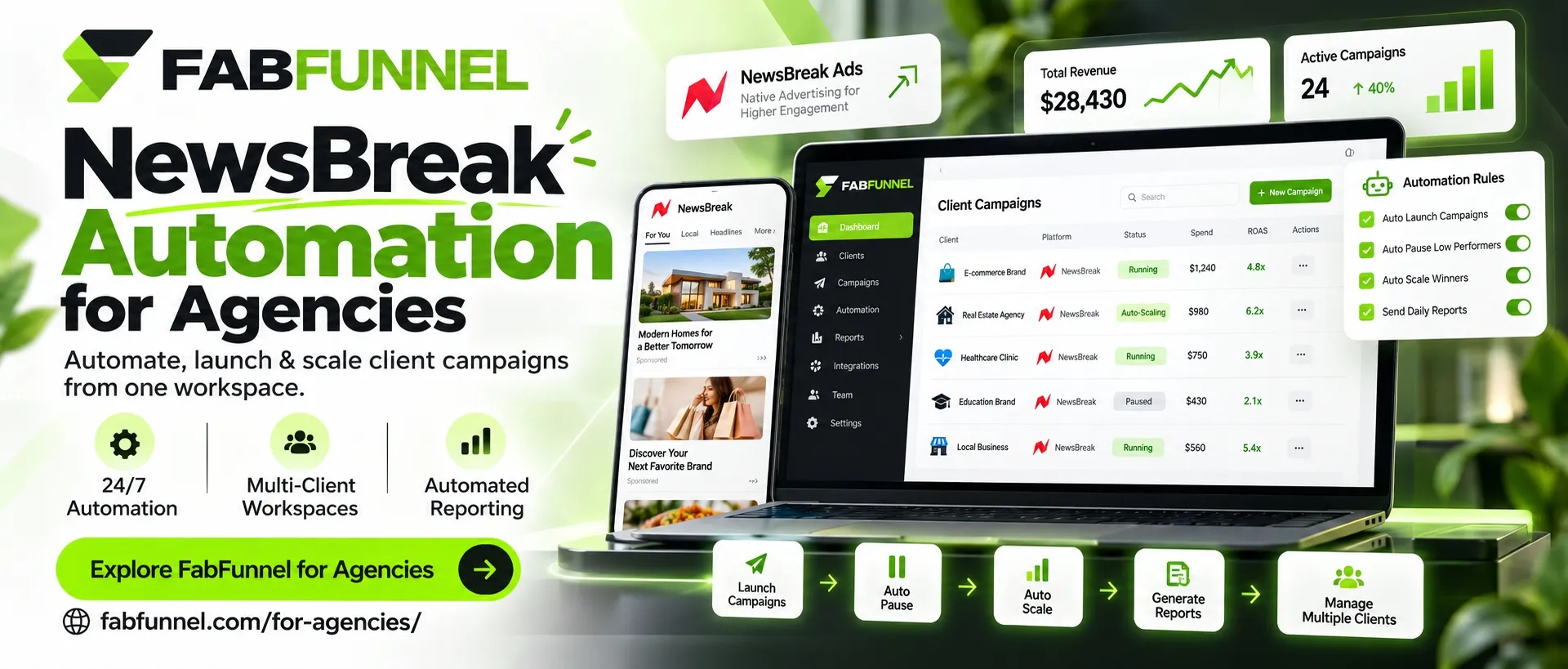
For agencies interested in this type of workflow, NewsBreak Automation for Agencies provides an example of how AI-powered tools can support more efficient agency advertising operations.
Creating More Creative Variations
Advertising performance can vary significantly depending on the message being used.
A headline that attracts attention from one audience may not have the same effect on another. The same applies to calls to action, value propositions, and creative concepts.
This is why testing multiple variations is important.
However, producing every variation manually can consume a lot of agency time.
AI-assisted tools can help generate different starting points more quickly. Marketing teams can then review these variations and identify the ideas that best fit the campaign.
The process might look like:
Campaign brief → AI-assisted concepts → Human review → Creative testing → Performance analysis → Optimization
This creates a more efficient cycle for campaign development.
Scaling Without Increasing Manual Work
One of the biggest benefits of automation is scalability.
An agency that adds new clients should be able to increase its capacity without creating an equal increase in repetitive tasks.
Standardized workflows can help achieve this.
For example, an agency could create a common process for collecting client information, developing advertising concepts, generating variations, reviewing creative, and preparing campaigns.
The workflow remains consistent while the messaging and creative strategy are customized for each client.
This allows agencies to handle more campaigns without constantly reinventing their internal processes.
Giving Marketers More Time for Strategy
Automation can also change how marketing teams spend their working hours.
If marketers spend less time producing repetitive variations, they can devote more attention to strategic responsibilities.
These can include:
-
Audience research
-
Campaign planning
-
Competitor analysis
-
Performance evaluation
-
Creative strategy
-
Client communication
-
Conversion optimization
These activities require human judgment and can have a significant impact on campaign effectiveness.
Automation should therefore be measured not only by how much content it produces but also by how much valuable time it gives back to the marketing team.
Human Oversight Is Still Essential
AI-generated content should always be reviewed before publication.
A marketing team needs to make sure that the final advertisement reflects the client's brand voice, communicates accurate information, and is appropriate for the intended audience.
AI can generate possibilities, but it does not automatically understand every aspect of a client's business.
Human marketers provide context and judgment.
This makes a combined human-AI workflow more practical than attempting to automate the entire advertising process.
Choosing an Automation Solution
Agencies considering advertising automation should focus on their actual workflow challenges.
Important factors may include:
-
Ease of use
-
Creative generation capabilities
-
Ability to produce variations
-
Scalability
-
Support for agency workflows
-
Brand consistency
-
Time-saving potential
-
Flexibility across campaigns
The ideal platform should simplify the workflow rather than introduce unnecessary complexity.
Agencies should also evaluate whether the tool can provide meaningful time savings across multiple campaigns and clients.
The Future of Agency Advertising
AI and automation are likely to become increasingly important in digital advertising.
As agencies manage larger numbers of campaigns, efficiency will become a competitive advantage. Teams that can reduce repetitive work may have more time to focus on creative strategy, client relationships, research, and optimization.
However, automation will not eliminate the need for experienced marketers.
Successful campaigns still require an understanding of customers, positioning, messaging, and business objectives.
The future is more likely to involve collaboration between technology and marketing professionals.
Conclusion
Digital marketing agencies face an ongoing challenge: producing more advertising work while maintaining quality and strategic focus.
Automation can help by streamlining repetitive tasks and making creative production more efficient. AI can further support this process by generating ideas and variations that marketers can review and refine.
For agencies exploring new advertising channels and more scalable workflows, AI-assisted automation can be a valuable addition to their marketing toolkit.
The key is to use automation thoughtfully. When technology handles repetitive production and marketers remain responsible for strategy and quality control, agencies can build workflows that are faster, more scalable, and better suited to the demands of modern digital advertising.


