
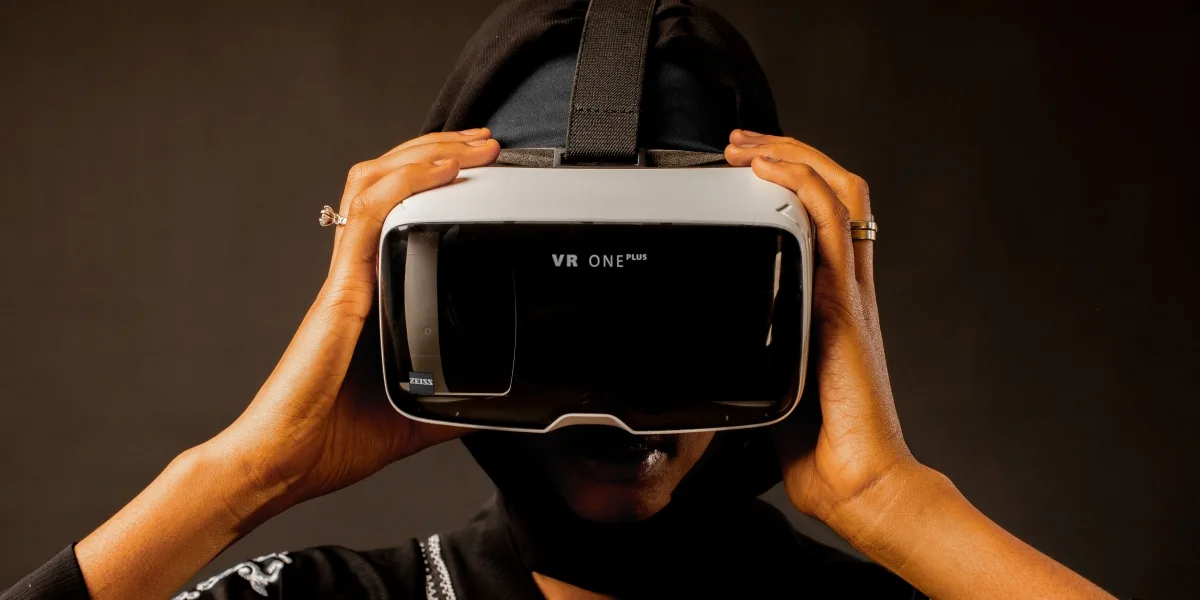
For years, digital interaction has been defined by screens. Users click, scroll, and navigate fixed interfaces. That model is changing.
Augmented and virtual reality put users inside the experience rather than observing it from a distance. In Half-Life: Alyx, interaction is built around physical movement — reaching, grasping, manipulating objects. Fortnite and Roblox have expanded beyond gameplay into persistent spaces where people attend events and create content.
As experiences move toward immersion, expectations of the people building them change too.
XR changes the foundation of design
XR is usually defined as augmented, virtual and mixed reality combined. That's accurate but shallow. What matters is that the environment isn't just viewed — it's navigated. The user's position, movement and perspective become part of the system.
That raises questions screen design never had to answer. How does someone orient themselves with no fixed frame? What guides attention without a screen hierarchy? How should interactions respond to natural movement rather than input devices?
These aren't technical adjustments. They demand spatial awareness, interaction flow, and sensitivity to comfort and scale — factors that directly determine how long someone can stay engaged.
How XR Development is Shaping the Future of Digital Experiences
Demand is spreading across industries
XR adoption isn't confined to entertainment. Healthcare uses simulation-based training for surgery and emergency response. Retail uses AR product visualisation before purchase. Education builds immersive environments that improve retention, and corporations run scenario-based skill simulations.
These are implementations, not experiments — and they raise the bar. A training simulation must guide users without confusion. A retail experience must build trust in a decision. So alongside developers, organisations need people who can think in user journeys, interaction flow, and behavioural response — skills sitting at the intersection of design, storytelling and technology.
Key Trends in Augmented and Virtual Reality in 2025
A structured learning path matters at this stage. MAGES Institute offers industry-aligned programs that build technical capability alongside experience-driven thinking.
Good code isn't enough
An XR application can be technically sound and still fail. Disorientation from missing spatial guidance, fatigue from unnatural movement, confusion from unclear visual cues — each breaks usability while the system works exactly as built.
That's why the line between "creator" and "developer" is blurring. What matters is the ability to contribute to the whole experience.
If you want to move beyond tools and design real immersive experiences, MAGES Institute offers a structured path to learn AR/VR technology.
Where learners get stuck
Most start with Unity or Unreal and stay at the tool layer, building surface familiarity without understanding spatial design or interaction logic. Tutorials get consumed in isolation, projects stay incomplete, and there's no feedback loop.
A better approach reverses the order:
- Start with a use case, not a tool — an AR retail placement app, a VR training module. Tools then serve the goal.
- Build spatial thinking alongside technical skill: layout, navigation flow, scale, depth, comfort.
- Prioritise interaction over visual polish. If engagement isn't intuitive, the experience breaks regardless of how it looks.
- Complete end-to-end projects rather than exercises.
- Build a portfolio showing thinking, not just finished output.
MAGES Institute offers structured XR development programs focused on practical learning and industry-ready outcomes.


