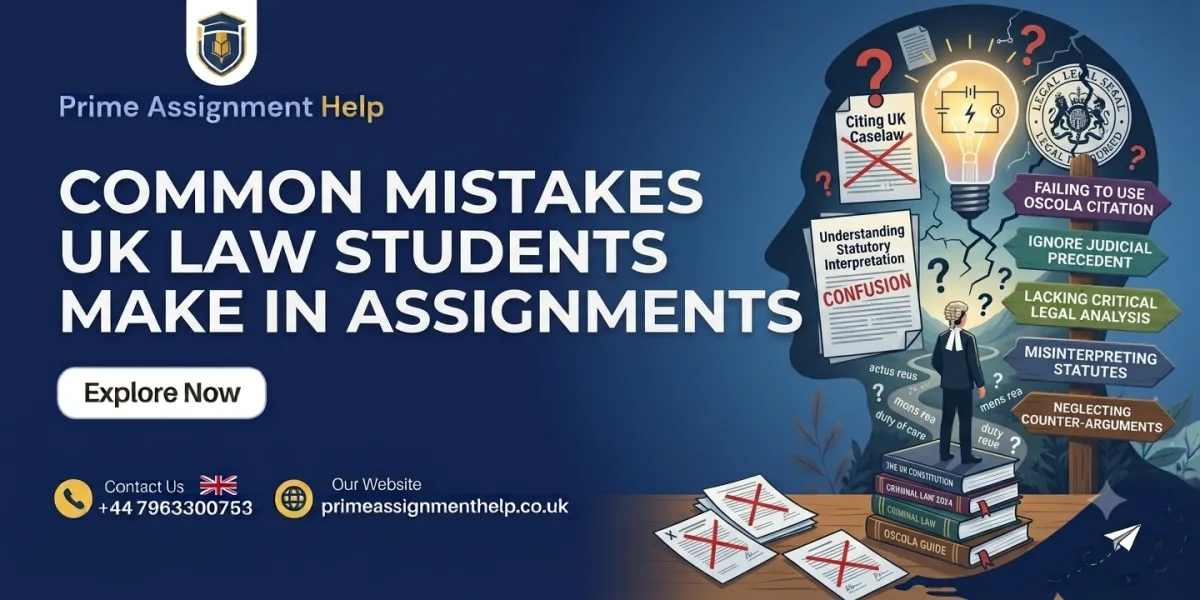
Anyone who has marked a first-year law essay knows the pattern before they've read the first paragraph. Same structure, same missed question, same referencing panic on page four. If you've ever searched for Law Assignment Help at 1am with a deadline six hours away, you already know how this feels from the other side of the desk. The good news is that almost every mistake law tutors see is avoidable once you know what it looks like.
Law assignments aren't marked like other essays. A brilliant argument built on the wrong question still fails. A well-written piece with no case authority still fails. Examiners are trained to spot shortcuts, and the mistakes below are the ones that show up on feedback sheets term after term, year after year.
Not Actually Answering the Question Set
This is the single biggest reason for lost marks, and it rarely looks like carelessness. A student reads "critically evaluate the doctrine of consideration" and writes a perfectly accurate description of what consideration is. The information is correct. The mark is still low, because description isn't evaluation.
Process words matter more than most students realise. "Discuss," "analyse," "critically assess" and "explain" all ask for different things. Before writing a single line, underline the instruction word and the subject matter separately, then check what each one is actually demanding. A five-minute habit here saves entire assignments.
Treating Case Law as Decoration
Dropping a case name into a sentence isn't the same as using it. Weak assignments cite Donoghue v Stevenson and move on, assuming the reader already knows why it matters. Strong ones explain the facts briefly, state the ratio, and then connect it directly to the argument being made. If a case could be deleted from the paragraph without changing the meaning, it wasn't doing any work.
This is also where students lose marks on currency. Citing a case that's been overruled, or missing a more recent authority that's shifted the law, signals thin research rather than a simple oversight to most markers.
Getting OSCOLA Wrong (or Ignoring It Entirely)
Referencing in law degrees is unforgiving compared with other subjects, and OSCOLA has its own quirks: footnotes instead of in-text citations, specific punctuation for case names, pinpoint references for direct quotes. Getting the format slightly wrong across a whole piece looks worse than one missed citation, because it suggests the student never checked the guide at all.
A few habits fix most of this:
- Footnote as you write, not at the end, when you still remember which source said what
- Keep a running bibliography from day one rather than reconstructing it the night before submission
- Check your law school's specific OSCOLA variant, since some faculties adjust the standard rules slightly
Writing Description Instead of Argument
Law assignments reward a position, defended with evidence, not a tour of everything you learned in the seminar. Students often list three arguments for one side and three for the other, then end with a sentence like "there are valid points on both sides." That's not a conclusion; it's an unfinished essay.
Pick a position early, even a qualified one, and structure every paragraph to build toward it. Where the law is genuinely contested, say so and explain why, rather than refusing to commit at all.
Poor Time Management Around Research
Procrastination on a law assignment is different from procrastination on other coursework, because the research phase itself takes longer. Reading a single Court of Appeal judgment properly, plus the academic commentary on it, can eat an entire evening. Starting three days before the deadline usually means skimming secondary sources instead of reading primary ones, which markers notice immediately in the quality of analysis.
Building in research time as its own block, separate from writing time, tends to produce sharper essays even when the total hours spent don't change much.
Ignoring the Word Count Until the End
Legal arguments need room to breathe, and students frequently discover they're 800 words over with two sections still unwritten. The usual fix, cutting evenly from every paragraph, damages the strongest sections along with the weakest. Better to draft a rough word budget per section before writing, so the introduction doesn't quietly eat the space that the analysis needed.
Skipping the Final Proofread for Structure
Most students proofread for typos. Far fewer reread for structure, checking whether each paragraph still follows logically from the one before it after all the editing and rewriting. A paragraph moved during a late-night edit can leave an argument that no longer flows, even when every sentence inside it is grammatically fine. Reading the essay aloud, or reading it backwards paragraph by paragraph, catches structural gaps that a normal read-through misses.
What Actually Helps
None of this requires natural talent for law, just deliberate habits: reading the question twice before researching, using cases as evidence rather than decoration, referencing as you go, and leaving real time for both research and a proper structural edit. Students who build these into their routine tend to see the improvement show up within a single term, not gradually over a whole degree.
Conclusion
Every mistake on this list has the same root cause: rushing past the planning stage to get to the writing. Slow down at the start, and the rest of the assignment gets noticeably easier. Reread the question until you're certain what it's asking, treat every case you cite as a building block rather than a name-drop, and leave enough room in your schedule to edit for structure, not just spelling. If you're working through a difficult brief and want a second pair of eyes on your argument, general Assignment Help UK services can be useful for feedback, though the habits above are what genuinely move the grade.