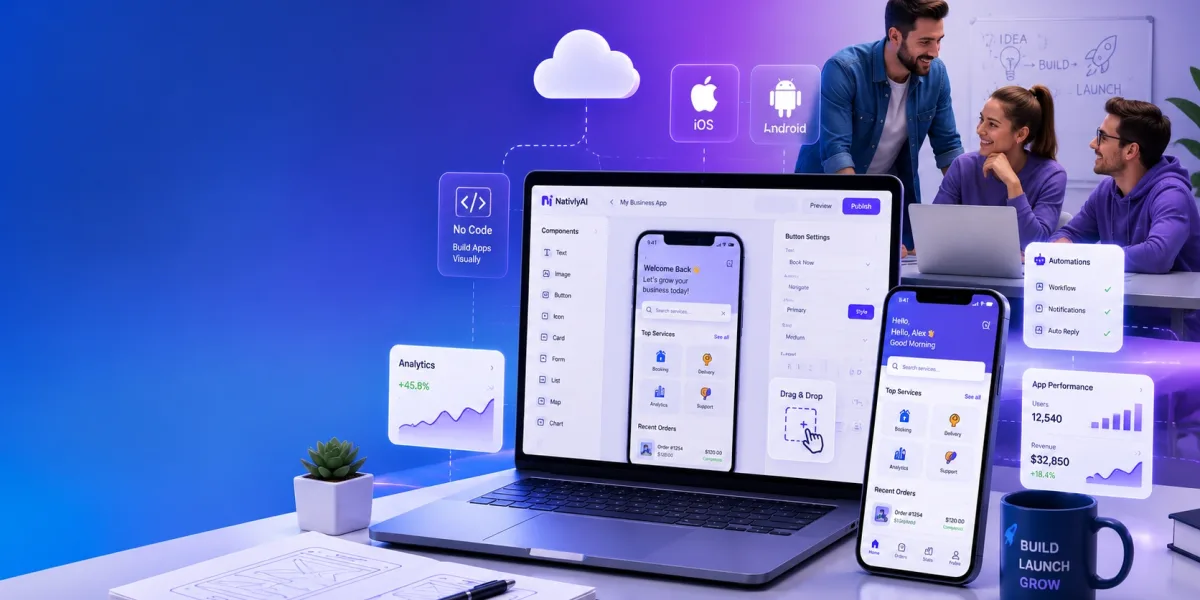
Building a mobile MVP is one of the fastest ways for a startup to discover whether an idea has real potential. Instead of spending months creating a fully developed product, an MVP allows a team to launch the essential experience, put it in front of users, and learn from their reactions. The challenge is that even a small mobile application can involve interface design, navigation, data handling, authentication, testing, and deployment. For founders working with limited budgets or small teams, traditional development can make this first step feel unnecessarily expensive.
This is where an AI app builder can change the development process. Modern platforms can assist with creating screens, organizing workflows, generating components, connecting data, and making product changes through simpler instructions. Rather than beginning with a blank coding environment, founders can start with the problem they want to solve and gradually turn that concept into a usable application. The technology does not replace thoughtful product planning, but it can reduce the amount of technical work required to test an early idea.
For teams considering this approach, choosing the right platform matters. Some tools are designed mainly for prototypes, while others provide features intended for applications that can continue beyond the MVP stage. Options such as Nativly AI app builder are part of the growing category of platforms that aim to make mobile product development more accessible. Before selecting one, startups should look at customization, integrations, publishing options, data management, pricing, scalability, and how easily the application can evolve after the first release.
Why AI App Builders Are Useful for Mobile MVPs
The purpose of an MVP is learning, not perfection. A startup needs enough functionality to test its central idea without investing heavily in features that may eventually be removed. AI-assisted development can support this approach by making it easier to create a focused first version and adjust it as feedback arrives.
Speed can be particularly valuable during the validation stage. If a team can build a working version in less time, it can begin collecting real-world feedback sooner. Instead of debating every detail internally, founders can watch users interact with the product and identify what needs to change. An AI mobile app builder can therefore become part of the research and experimentation process, not simply a shortcut for creating software.
Build Only What Users Need First
A successful MVP should concentrate on its main customer problem. If an application is designed to help people schedule local services, for example, the first release may only require account creation, service selection, scheduling, confirmations, and basic profile management.
Additional features can wait until there is evidence that they are valuable. This keeps the product easier to build and easier for users to understand. It also gives the development team a clear foundation for deciding what should be added next.
Turn Feedback Into Product Changes
One of the biggest advantages of an MVP is the information it generates. Users may ignore a feature the team considered essential or repeatedly request something that was not included in the original plan.
A flexible development platform makes those discoveries easier to act upon. Teams can adjust screens, simplify workflows, modify content, or experiment with alternative user journeys without treating every change as a completely new development project.
Features to Look for in an AI App Builder
Not every AI development platform is built for the same purpose. Some are excellent for demonstrations and basic prototypes, while others provide a broader collection of tools for creating applications that can grow. Startups should therefore compare capabilities against the actual requirements of their MVP.
Important areas include interface customization, database functionality, authentication, integrations, testing, deployment, analytics, and support for future updates. It is also worth examining how the platform handles applications when the number of users increases. An MVP may start small, but a product that gains traction can quickly develop more demanding technical requirements.
Visual Design and User Experience
A mobile MVP still needs to be pleasant and understandable. Users should be able to navigate the application without having to figure out complicated menus or unnecessary steps.
Look for a platform that provides control over layouts, navigation, typography, colors, forms, buttons, and other interface elements. Templates can speed up the initial design, but customization allows the product to develop its own identity and adapt to customer feedback.
Data, Authentication, and Integrations
Many MVPs require more than a collection of screens. They may need user accounts, stored information, notifications, payments, maps, analytics, or connections to external services.
Before choosing a platform, create a list of the services required for the first release. Then check whether those connections are supported directly or can be added through APIs and other integration methods. This simple step can prevent technical limitations from appearing after development has already begun.
How Nativly AI Fits Into Mobile MVP Development
The growing interest in AI-assisted development reflects a broader change in how people approach software creation. Rather than requiring every part of an application to be manually constructed from the beginning, newer tools can help users move through development with a combination of automation, natural-language instructions, and visual configuration.
Nativly AI mobile app builder is positioned within this changing landscape, where accessibility and faster experimentation are important considerations for product teams. For an MVP-focused startup, the value of such a platform can be measured by how effectively it helps transform a product concept into something customers can actually use and evaluate.
From Concept to Interactive Prototype
A written product idea can sound convincing without revealing how the actual user experience will work. A prototype changes that because users can interact with screens and workflows instead of simply reading about them.
For founders, this creates an opportunity to identify usability issues much earlier. A confusing registration process, an unclear call-to-action, or an overly complicated checkout flow becomes easier to recognize when someone interacts with the product directly.
Keeping the First Version Flexible
An MVP is rarely the final version of a product. It is a starting point that should evolve as the team learns more about its customers.
That makes flexibility particularly important. A platform should allow the team to make reasonable changes without rebuilding the entire application. Being able to experiment with new screens, workflows, and features can help startups respond to customer feedback while keeping development manageable.
Choosing the Right Builder for Your MVP
The right platform depends on what you are trying to validate. A simple content application may have very different requirements from a marketplace, social platform, booking service, or business management product. Start by defining the single most important action you want users to complete.
Once that is clear, identify the minimum technical requirements needed to support that action. This might include user accounts, a database, payments, notifications, search, location services, or an external API. Comparing platforms against this checklist is more useful than selecting a tool simply because it has a long feature list.
Test Before Making a Long-Term Commitment
A practical way to evaluate a development platform is to build a small section of the MVP before committing to a larger plan. Create the most important screen and one complete user journey.
Pay attention to how easy it is to make changes. If changing a simple workflow requires complicated workarounds, the platform may become frustrating later. A short trial project can reveal much more about the development experience than a feature comparison page.
Plan for What Happens After Validation
If your MVP succeeds, you may need more users, additional functionality, stronger analytics, improved performance, or custom engineering. The platform should fit into that potential future rather than becoming a dead end.
Consider questions such as whether the application can be expanded, how data is managed, what support is available, and whether developers can work with the project later. Thinking about these issues before launch can make the transition from MVP to a larger product smoother.
Common Mistakes When Building a Mobile MVP
The biggest mistake is often trying to build too much. Founders can become excited about their product and add every possible feature before anyone has used the basic version. This increases development time and makes it harder to understand which part of the product actually creates value.
Another common problem is focusing on technology while ignoring user behavior. A technically impressive application still needs a clear reason for people to return to it. The MVP should be built around a specific customer problem and a simple path toward solving it.
Avoid Feature Overload
Every feature introduces additional design, testing, maintenance, and support requirements. Adding features simply because competitors have them can make the MVP harder to understand.
Instead, ask whether each proposed feature is necessary for testing the central business assumption. If the answer is no, consider moving it to a later stage of the roadmap.
Do Not Ignore Real User Feedback
An MVP should not sit untouched after launch. Its purpose is to create a feedback loop between the product and its users.
Watch how people use the application, collect direct comments, examine relevant analytics, and look for repeated friction points. Then use those observations to decide what deserves attention next. This process can turn a basic first release into a product that is increasingly aligned with customer needs.
Final Thoughts
AI-assisted development is making mobile MVP creation more accessible to startups, entrepreneurs, and small product teams. By reducing some of the technical barriers involved in creating an initial application, these platforms can help teams move from an idea to real-world testing more efficiently.
An AI mobile app builder can be especially useful when the goal is experimentation. Instead of investing heavily before knowing whether customers want the product, a startup can create a focused version, gather feedback, and improve it through several development cycles. Platforms such as Nativly AI app builder are part of this wider movement toward simpler and more flexible software creation.
Still, the platform is only one part of the equation. A strong MVP needs a clearly defined problem, a focused feature set, thoughtful user experience, and continuous customer feedback. The smartest approach is to use AI-assisted development as a practical tool while keeping product decisions grounded in what users actually need.
For startups, the real advantage of an MVP is not simply getting an app into an app store. It is discovering what deserves to be built next. When development becomes easier to adapt, teams can spend more time learning, testing assumptions, and shaping a product that has a genuine purpose in the market.