Introduction
Altus Airflow understands that reliable HVAC and airflow performance is an important part of creating a controlled IVF laboratory environment. Temperature, humidity, filtration, air distribution, pressure relationships, and airflow direction all need to work together to support consistent laboratory conditions. During installation or upgrading of an IVF facility, Modular IVF Lab Setup Services involve more than simply installing air-handling equipment and ducts. The completed system needs to be tested to determine whether it is operating according to the intended design and project requirements. Proper testing can also identify airflow imbalance, filtration problems, pressure issues, or environmental variations before the laboratory becomes fully operational.
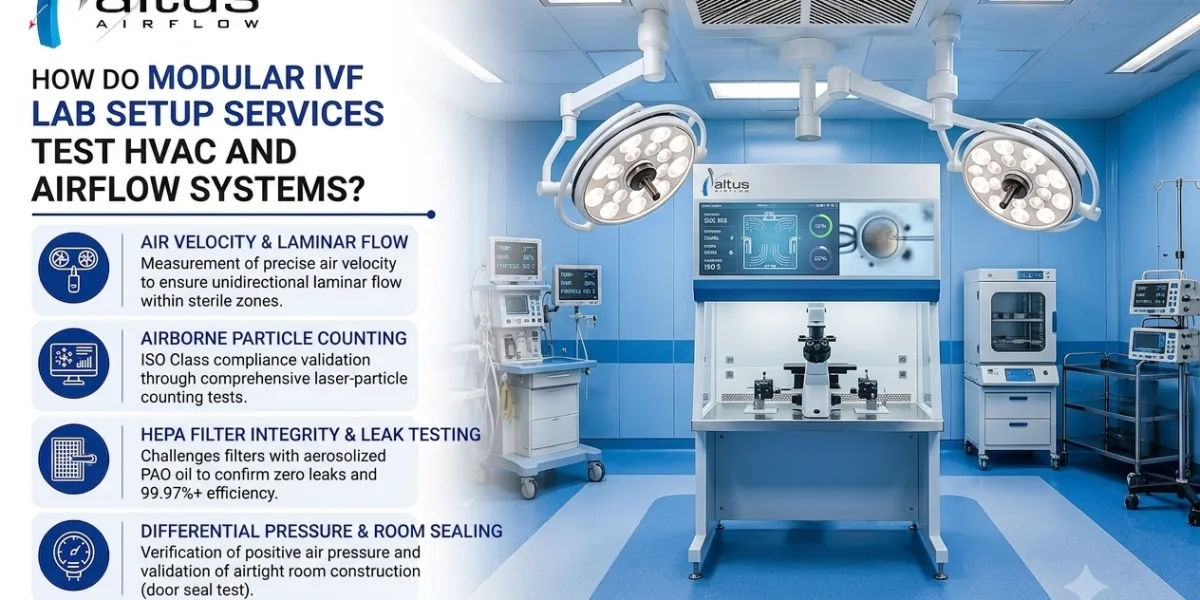
HVAC and airflow testing generally begins after installation and preliminary system balancing. The testing team evaluates the performance of air-handling units, filters, supply and return-air systems, room conditions, pressure relationships, and monitoring devices. Depending on the project, testing may include airflow measurements, air changes per hour, temperature and humidity verification, pressure differential measurements, HEPA filter integrity testing, airflow visualization, and environmental monitoring. These checks help establish whether the HVAC system is delivering the required conditions throughout the laboratory rather than only at individual supply points.
Why HVAC Testing Is Important in an IVF Laboratory
An IVF laboratory requires a carefully controlled environment because laboratory processes can be sensitive to environmental variations. HVAC systems influence temperature, humidity, filtration, air movement, pressure relationships, and overall air quality.
A system may appear to be functioning because the air-handling unit is running, but that does not necessarily mean every room is receiving the intended airflow. Poor distribution can create areas with inadequate ventilation, excessive air movement, temperature variation, or undesirable pressure relationships.
Testing provides measurable evidence of system performance. It helps project teams identify deviations and make adjustments before the facility enters routine operation.
Initial HVAC Inspection
Before detailed performance testing begins, the HVAC installation is visually inspected. The testing team may review air-handling units, ductwork, diffusers, grilles, filters, dampers, sensors, insulation, controls, and access panels.
The inspection also checks whether equipment has been installed according to the approved design. Duct connections should be properly secured, filters correctly installed, and airflow components accessible for maintenance.
Any obvious installation issues should be addressed before performance measurements are conducted. This prevents testing an incomplete or incorrectly configured system.
Measuring Supply and Return Airflow
One of the basic HVAC tests is measurement of airflow at supply and return points. Instruments such as anemometers, balometers, or other calibrated airflow measurement devices may be used depending on the system design.
The measured airflow at each point can be compared with the design requirement. If one supply diffuser delivers significantly more air than another, the system may require balancing.
Air balancing helps distribute airflow more consistently throughout the laboratory. Dampers and other control components can be adjusted to achieve the intended distribution.
Checking Air Changes Per Hour
Air changes per hour, commonly referred to as ACH, indicate how frequently the air volume of a room is theoretically replaced by the ventilation system.
The calculation considers the total airflow supplied to the room and the room volume. Testing teams can use measured airflow values to determine whether the achieved air-change rate corresponds with the design requirement.
ACH should not be considered in isolation. A laboratory may have an appropriate calculated air-change rate but still experience poor distribution. Therefore, ACH assessment is normally considered alongside airflow distribution and other environmental measurements.
Temperature Testing
Temperature testing determines whether the HVAC system can maintain the required temperature range throughout the laboratory.
Measurements may be taken at different locations and under operating conditions that represent normal laboratory use. Multiple measurement points can help identify areas that are warmer or cooler than others.
Temperature stability is particularly important because significant variations may indicate problems with airflow distribution, HVAC capacity, controls, insulation, equipment heat loads, or room zoning.
If variations are identified, the system can be adjusted and retested.
Humidity Testing
Humidity is another important environmental parameter in IVF laboratory HVAC testing. Excessive or insufficient humidity can affect room conditions and may influence condensation risks, equipment operation, and overall environmental stability.
Calibrated temperature and humidity instruments can be used to measure conditions at representative locations. Testing may be conducted over a period of time rather than relying only on a single reading.
Where humidity levels are outside the intended range, the HVAC system, controls, cooling performance, or humidification/dehumidification strategy may need to be reviewed.
Pressure Differential Testing
Pressure relationships between laboratory areas can be tested using differential pressure gauges or electronic pressure measurement devices.
The purpose is to determine whether the intended pressure relationship between adjacent spaces is being maintained. This can be particularly relevant where the laboratory design includes controlled zones with different environmental requirements.
Pressure testing should consider doors, access points, supply airflow, exhaust or return-air arrangements, and room leakage. If the expected pressure relationship is not achieved, airflow balancing or system adjustments may be required.
HEPA Filter Integrity Testing
Where HEPA filtration is incorporated into the laboratory HVAC design, filter integrity testing is an important part of commissioning.
A qualified testing process can be used to identify leaks in the filter media, frame, gasket, housing, or installation arrangement. The objective is to verify that the installed filtration assembly is functioning as intended.
Testing should be performed using appropriate calibrated equipment and established procedures. If leakage is detected, the source should be identified and corrected before the system is accepted.
Airflow Visualization and Smoke Studies
Airflow visualization can help demonstrate the direction and behavior of air movement within a controlled laboratory space.
A suitable visible tracer or smoke-generation method can be used under controlled testing conditions to observe whether airflow follows the intended path. This can help identify turbulence, unexpected air movement, stagnant areas, or undesirable airflow interactions.
The results should be interpreted by qualified personnel because visible airflow patterns can be influenced by room configuration, equipment placement, doors, personnel movement, and HVAC operating conditions.
Testing Airflow Uniformity
Airflow uniformity is different from simply measuring total room airflow. A laboratory can have sufficient overall airflow while still having uneven distribution.
Testing teams may take measurements at multiple locations to understand how evenly air is distributed. Variations can occur because of diffuser positioning, obstructions, duct design, damper settings, equipment placement, or room geometry.
If significant differences are identified, the airflow system can be balanced or modified to improve distribution.
Testing HVAC Controls and Sensors
Modern IVF laboratories may use digital controls and sensors for temperature, humidity, pressure, airflow, alarms, and HVAC operation.
Testing should verify that sensors provide appropriate readings and that the control system responds correctly to changes. For example, the system may be checked to confirm whether an alarm activates when an environmental parameter moves outside a defined limit.
Sensor calibration should also be considered. An inaccurate sensor can result in an incorrect control response even when the HVAC equipment itself is functioning properly.
Environmental Monitoring
Environmental monitoring systems can provide continuous information after HVAC commissioning. Depending on the laboratory design, monitoring may include temperature, humidity, pressure, and other relevant environmental parameters.
During commissioning, the monitoring system should be checked against independent measurements where appropriate. This helps confirm that displayed values correspond reasonably with calibrated testing instruments.
Monitoring records can also provide useful evidence for facility management, maintenance planning, and investigation of environmental deviations.
Checking Airflow Around Laboratory Equipment
HVAC testing should consider the effect of laboratory equipment and furniture on airflow. Equipment can obstruct supply or return points and change local air movement.
During testing, the laboratory should ideally be evaluated in a configuration that reflects actual operation. Large incubators, workstations, cabinets, and other equipment should be positioned according to the intended layout where practical.
If equipment causes significant airflow disruption, the layout or air distribution strategy may need to be reconsidered.
Filter and Air-Handling System Inspection
Filters should be inspected to ensure they are correctly installed and suitable for the designed filtration stages. Air-handling components should also be checked for cleanliness and accessibility.
Coils, fans, dampers, drain arrangements, and other components can influence HVAC performance. Poor maintenance access can create difficulties later, so the commissioning process can also identify practical service concerns.
The overall objective is to ensure that the system is ready for reliable operation and future preventive maintenance.
HVAC Balancing and Corrective Adjustments
If test results show deviations from design requirements, the HVAC system may require balancing or corrective adjustment.
Possible actions include adjusting dampers, modifying airflow settings, correcting sensor positions, improving sealing, changing control parameters, or addressing installation defects.
After adjustments are made, affected parameters should be retested. This creates a verification cycle in which measured performance is compared with the intended requirements until acceptable results are achieved.
Documentation of HVAC Testing
Documentation is an essential part of HVAC commissioning. Test reports can record the instruments used, measurement locations, measured values, test conditions, calibration information, and results.
Reports may also include airflow readings, temperature and humidity measurements, pressure differential results, filter testing information, and corrective actions.
Good documentation provides a reference for future maintenance and troubleshooting. It can also support facility quality systems and inspections where applicable.
Role of Modular IVF Lab Setup Services in HVAC Testing
Modular IVF Lab Setup Services can coordinate HVAC testing as part of a broader laboratory setup and commissioning process. Instead of treating HVAC as an isolated installation, the service provider can coordinate it with modular construction, electrical systems, laboratory equipment, monitoring, utilities, and room layout.
This integrated approach is useful because changes in one system can influence another. For example, moving equipment may affect airflow, while modifying room partitions can change pressure relationships and air distribution.
Coordination between different project teams helps reduce such conflicts and supports a more organized commissioning process.
What Happens If HVAC Testing Shows a Problem?
Testing is intended to identify problems before routine laboratory operation. If results fall outside the project's specified requirements, the issue should be investigated rather than simply accepting the system.
The corrective action depends on the cause. A problem could result from incorrect balancing, a control issue, an installation defect, insufficient HVAC capacity, leakage, sensor error, or changes made during construction.
After corrective work, the affected system should be tested again. Final acceptance should be based on documented results and applicable project requirements.
Periodic HVAC Performance Checks
HVAC testing should not necessarily be considered a one-time activity. Performance can change because of filter loading, equipment wear, modifications, sensor drift, changes in room use, or maintenance issues.
Periodic inspection and performance verification can help identify problems before they become significant. The frequency should be established according to the facility's operational requirements, system design, maintenance plan, and applicable standards.
Regular monitoring can also help identify gradual changes in temperature, humidity, pressure, or airflow.
Benefits of Proper HVAC and Airflow Testing
A structured testing and commissioning process provides several benefits for an IVF laboratory. These include:
-
Verification of HVAC performance
-
Better understanding of airflow distribution
-
Identification of filtration problems
-
Verification of temperature and humidity control
-
Confirmation of pressure relationships
-
Detection of sensor or control issues
-
Improved maintenance planning
-
Documented commissioning results
-
Support for consistent laboratory environmental conditions
-
Early identification and correction of installation problems
Testing does not replace proper laboratory procedures or operational controls, but it provides important evidence that the installed environmental systems are performing as intended.
Selecting a Suitable HVAC Testing Partner
When choosing a provider, laboratories should consider experience with controlled healthcare and laboratory environments. The provider should understand airflow measurement, filtration, pressure relationships, environmental monitoring, HVAC balancing, testing instruments, and commissioning documentation.
The testing scope should be defined before the project begins. It should specify the parameters to be measured, acceptance criteria, test procedures, reporting requirements, and corrective-action process.
A coordinated approach is especially useful for new or renovated IVF laboratories because HVAC performance is closely connected to the room layout, modular construction, equipment, electrical systems, and monitoring infrastructure.
Conclusion
HVAC and airflow testing is an important stage of IVF laboratory setup because it verifies whether the installed environmental systems are performing according to their intended design. Modular IVF Lab Setup Services can coordinate airflow measurements, air-change calculations, temperature and humidity testing, pressure differential checks, HEPA filter integrity testing, airflow visualization, sensor verification, HVAC balancing, and commissioning documentation. Proper testing can help identify deviations early and provide a documented basis for system acceptance and future maintenance.
For IVF laboratories seeking an integrated approach to environmental and infrastructure planning, Altus Airflow can support coordinated HVAC and modular laboratory requirements. With appropriate planning, testing, commissioning, and documentation, Altus Airflow can help facilities establish controlled laboratory environments that are practical to operate and maintain.
FAQs
1. How do Modular IVF Lab Setup Services test HVAC and airflow systems?
Modular IVF Lab Setup Services can test HVAC systems through airflow measurements, air-change calculations, temperature and humidity checks, pressure differential testing, HEPA filter integrity testing, airflow visualization, sensor verification, and system balancing.
2. Why is airflow testing important in an IVF laboratory?
Airflow testing helps verify that air is distributed according to the intended design and can identify uneven airflow, pressure issues, or other environmental deviations.
3. How are HEPA filters tested?
HEPA filters can undergo integrity testing using appropriate calibrated testing equipment and established procedures to identify leaks in the filter or its installation.
4. Is temperature and humidity testing part of HVAC commissioning?
Yes. Temperature and humidity are commonly measured at representative locations to verify environmental stability.
5. What is pressure differential testing?
Pressure differential testing measures the pressure relationship between adjacent rooms or zones to determine whether the intended airflow direction and pressure conditions are being maintained.
Read Our Previous Blog ---------------> What quality assurance measures are followed in Andrology Room Setup Services?