
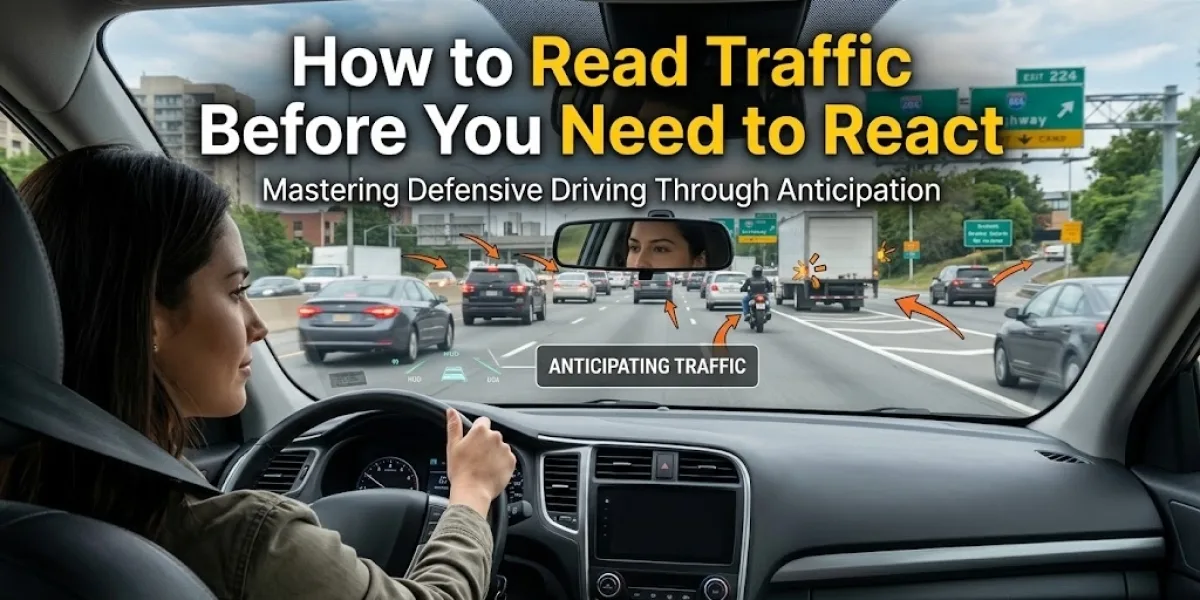
Safe driving is not just about knowing when to brake, steer, or accelerate. Some of the best driving decisions happen before you actually need to react. Experienced drivers develop the ability to look beyond the vehicle immediately in front of them, recognize patterns in traffic, and anticipate what might happen next. This habit creates more time and space to respond calmly instead of making sudden decisions.
Learning to anticipate traffic is a skill that can be developed with practice. Whether you are a new driver building confidence or someone looking to improve everyday driving habits, taking Driving Lessons Richmond can help you develop better observation, positioning, and decision-making skills. The goal is not to predict everything perfectly, but to notice useful clues early enough that you have options when conditions change.
What Does It Mean to Read Traffic?
Reading traffic means continuously observing your surroundings and using available information to anticipate possible changes. Instead of focusing only on what is happening directly ahead, you build a broader picture of the road.
For example, imagine you are approaching an intersection and the traffic light ahead is green. A driver who reacts only to the current signal may continue at the same speed. A driver who reads the situation might notice that the light has been green for a while, pedestrians are waiting nearby, and vehicles are beginning to slow in the opposite direction.
None of these clues guarantees that the light will change. However, they suggest that being prepared to slow down could be sensible.
Traffic reading is essentially anticipation without assumption. You observe what is happening, consider what could happen next, and position yourself so that you can respond safely.
Look Farther Ahead Than the Vehicle in Front
One of the most useful habits is to avoid staring at the vehicle immediately ahead.
Your eyes should regularly scan farther down the road. Looking several vehicles ahead can reveal developing situations before they reach you.
Why Looking Ahead Matters
Suppose the car directly in front of you suddenly brakes. If you were watching only that car, the braking may feel unexpected. But if you were also looking beyond it, you might have already noticed:
- A vehicle merging into traffic
- Congestion forming ahead
- A pedestrian approaching a crossing
- A car turning across the road
- Road construction
- A traffic signal changing
- A cyclist moving toward the lane
- Vehicles slowing around a bend
Seeing these things early gives you more time to adjust your speed.
This is particularly important in busy urban areas where several events can happen at once. The farther ahead you can effectively observe, the less likely you are to be surprised by something that was actually developing in plain sight.
Watch for Changes in Vehicle Behavior
Traffic has a rhythm. When that rhythm changes, it can provide an important warning.
If several vehicles ahead suddenly begin slowing, there is probably a reason. You may not know what the reason is yet, but the change itself is useful information.
Similarly, watch for vehicles that:
- Drift slightly within their lane
- Brake repeatedly
- Accelerate and then slow down
- Signal late
- Move toward a different lane
- Leave unusually large gaps
- Approach an intersection too quickly
- Appear distracted or uncertain
You do not need to label the other driver or assume they will make a mistake. Simply recognize that unpredictable behavior may require additional space.
A good rule is: when another driver's behavior becomes difficult to read, give yourself more room.
Use Brake Lights as Early Warning Signals
Brake lights are among the easiest traffic clues to recognize, but they become much more useful when you look beyond the nearest vehicle.
If you see brake lights several cars ahead, begin considering why traffic may be slowing. You may not need to brake immediately, but you can ease off the accelerator and prepare.
This is different from reacting aggressively to every brake light.
Instead, think in stages:
- Notice the change.
- Identify what may be causing it.
- Check your following distance.
- Adjust your speed if necessary.
- Prepare for further changes.
This approach makes your driving smoother because you are responding progressively rather than waiting until the situation becomes urgent.
Pay Attention to Intersections
Intersections deserve special attention because traffic can approach from several directions.
Before entering an intersection, look for more than just the traffic signal. Check for turning vehicles, pedestrians, cyclists, stopped traffic, and vehicles that may not have noticed the signal.
Look Beyond the Signal
A green light does not automatically mean that the path ahead is completely clear.
For example, a vehicle turning left may still be crossing your path. A pedestrian may be entering a crosswalk. A vehicle ahead could be stopped even though your signal is green.
The habit to develop is simple: green means you may proceed when the way is clear; it does not mean you stop observing.
Read the Road, Not Just the Cars
Traffic conditions are influenced by the road itself.
A bend can hide stopped traffic. A hill can reduce your view of what is ahead. Narrow lanes can make vehicles harder to maneuver. Parked cars can conceal pedestrians or cyclists.
Road features should therefore become part of your traffic-reading process.
Watch for Limited Visibility
Whenever your view is restricted, assume there may be something you cannot see yet.
This does not mean driving unnecessarily slowly. It means adjusting your speed and positioning so that you have enough time to respond if something appears.
For example, when approaching the crest of a hill, you cannot see whether traffic has stopped on the other side. Maintaining a manageable speed gives you more options than approaching at a speed that leaves little room to react.
Anticipate Pedestrians and Cyclists
People walking and cycling do not always move in predictable patterns.
A pedestrian standing near a crosswalk may be preparing to cross. Someone looking toward the road may be about to step forward. A cyclist approaching a parked vehicle may need to move farther into the traffic lane to avoid an opening car door.
You do not need to guess exactly what another road user will do. Instead, notice when there is a potential conflict.
Ask yourself:
“If this person moves into my path, do I have enough time and space to respond?”
If the answer is uncertain, create more space or reduce your speed.
Notice Vehicles That May Become a Problem
Some vehicles deserve additional attention because their position or behavior creates uncertainty.
A car waiting at a side street may enter your lane. A vehicle beside you may be preparing to change lanes. A parked vehicle with someone sitting inside could pull away. A delivery truck may suddenly stop.
Again, anticipation is not about assuming the worst. It is about maintaining awareness of possibilities.
A useful technique is to keep asking yourself what the vehicles around you might do next.
If a car is approaching a driveway, it could turn. If a vehicle is traveling unusually slowly, it might stop. If a driver is positioned close to the lane line, they may be preparing to change lanes.
You do not have to react to every possibility. Simply keeping these possibilities in mind helps you avoid being caught completely off guard.
Maintain a Space Cushion
Anticipation works best when you have enough space to act on what you see.
Following too closely removes valuable reaction time. Even if you notice a problem early, you may not have enough distance to respond smoothly.
A reasonable following gap gives you time to:
- Recognize developing hazards
- Lift off the accelerator
- Brake gradually
- Change your position when appropriate
- Avoid unnecessary emergency maneuvers
Space also helps when the unexpected happens. A vehicle ahead may brake harder than expected, or something may enter the roadway. More distance gives you more choices.
Use Mirrors to Build the Bigger Picture
Reading traffic is not only about looking forward.
Regular mirror checks help you understand what is happening around and behind your vehicle. This becomes especially important before changing lanes, slowing significantly, turning, or dealing with congestion.
Knowing that a vehicle is close behind you can affect how you respond to something ahead. For instance, if traffic suddenly slows and another vehicle is following closely, you may need to brake smoothly and give the driver behind as much warning as possible.
Mirrors should support your forward observation rather than distract from it. Develop a regular scanning routine so that you maintain awareness without staring at any single area for too long.
Avoid Getting Trapped by Tunnel Vision
One of the biggest obstacles to anticipating traffic is tunnel vision.
Drivers can become overly focused on one vehicle, one lane, a navigation instruction, or a traffic signal. Meanwhile, important information develops elsewhere.
Try to keep your attention moving naturally:
Far ahead → immediate path → mirrors → sides → far ahead again.
This continuous scanning helps you maintain a more complete understanding of the traffic environment.
It also reduces the chance that one sudden event will feel completely unexpected.
Practice Anticipation During Everyday Drives
You do not need complicated exercises to improve this skill.
During normal driving, challenge yourself to identify developing situations before they reach you.
For example, when approaching slow traffic, ask:
- What is causing the slowdown?
- Is traffic likely to stop completely?
- Which vehicles might change lanes?
- Is there an intersection ahead?
- Are pedestrians nearby?
- Do I have enough space if the vehicle ahead brakes?
Afterward, compare your expectation with what actually happened.
Over time, this builds a mental library of common traffic patterns. You begin recognizing situations more quickly because they are no longer completely unfamiliar.
Give Yourself Time Instead of Chasing Perfect Reactions
A common misconception about good driving is that skilled drivers react extremely quickly. In reality, strong drivers often avoid needing a last-second reaction in the first place.
They notice developing situations early, adjust their speed, maintain space, and prepare for multiple possibilities.
That is the real advantage of anticipation.
You cannot control every driver, pedestrian, cyclist, weather condition, or road hazard. What you can control is how much time and space you give yourself to respond.
Conclusion
Learning to read traffic before you need to react can make driving calmer, smoother, and safer. Look farther ahead, watch for changes in vehicle behavior, pay attention to intersections and road conditions, anticipate possible movements without making assumptions, and maintain enough space to respond comfortably. With consistent practice, these habits can become almost automatic. Developing them through structured instruction and real-world practice can also make a meaningful difference, and Benche Driving School can be a useful option for drivers looking to strengthen their observation and road-awareness skills. The goal is not to predict every event it is to see developing situations early enough that you always have a safer choice.


