
In digital business, there is a dangerous assumption that a website is working perfectly simply because nobody has sent an angry email yet. Most founders, marketing directors, and business owners assume their infrastructure is completely fine unless a catastrophic server crash triggers an immediate internal alarm.
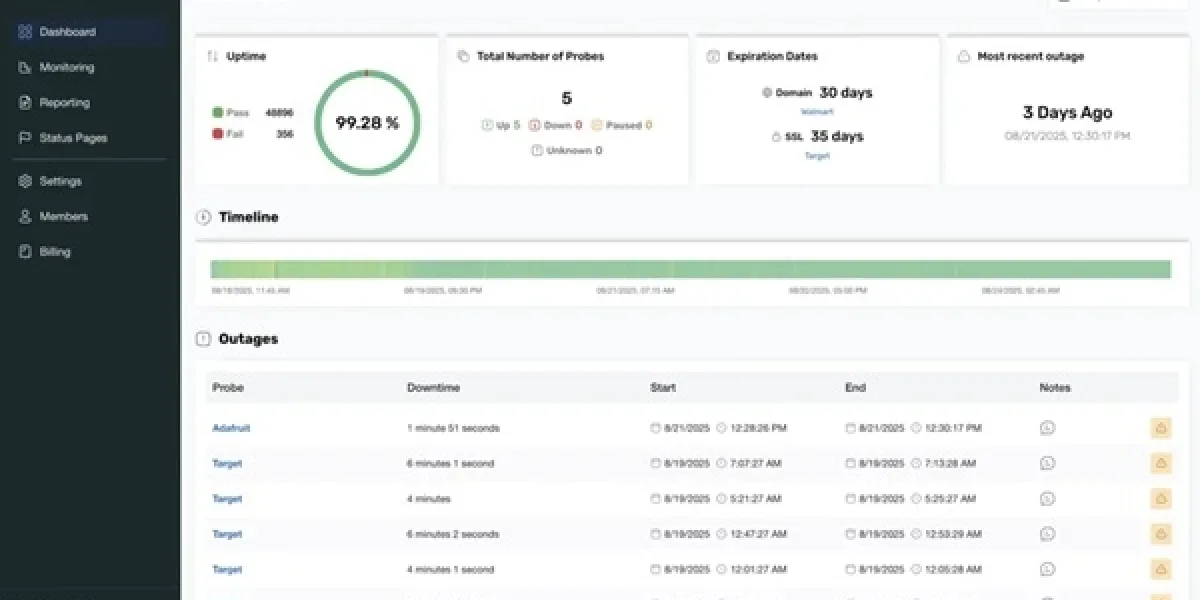
The reality of modern web infrastructure is much more nuanced. Websites rarely fail in an obvious, all-or-nothing manner. Instead, they bleed revenue through micro-outages, broken database connections, expired security certificates, and localized routing failures that fly under the radar of internal teams. This phenomenon is known as silent downtime. While your office network might load your homepage without hesitation, hundreds of potential buyers across the world could be staring at a blank screen or a timeout error.
Digital reliability is no longer an isolated technical metric reserved for system administrators. Website availability directly dictates customer acquisition costs, brand perception, organic search performance, and bottom-line revenue. Understanding the true scope of downtime and putting reliable systems in place to prevent it is one of the most critical responsibilities of running an online presence.
The Immediate and Indirect Financial Damage of Outages
When a web property goes offline, the loss is immediate, measurable, and rarely recoverable. The most visible impact occurs at the point of conversion. If an e-commerce platform experiences an outage during peak shopping hours, every second of unavailability represents abandoned carts and broken checkout funnels. Consumers who are ready to enter their credit card information will not wait patiently for a server restart. They will simply click the back button and complete their purchase with a direct competitor.
Beyond direct sales losses, silent downtime severely damages marketing efficiency. Modern organizations invest heavily in customer acquisition channels, including paid search campaigns, programmatic advertising, paid social, and influencer partnerships. When your site goes down, these ad campaigns do not magically pause themselves. Ad platforms continue serving impressions and charging your account for clicks that lead directly to a 500 internal server error or a gateway timeout. You are effectively paying premium advertising costs to deliver a broken experience to prospective buyers.
The financial ripple effect extends into your customer acquisition metrics. When a first-time visitor experiences a broken page, the cost invested in earning that click is permanently wasted. To win that person back, your marketing team must retarget them and convince them that your platform is legitimate, essentially doubling your acquisition cost for a single transaction. Over months of recurring, undetected micro-outages, this friction inflates operational expenses and significantly compresses profit margins.
Brand Perception and Modern Consumer Psychology
User patience online has reached an all-time low. Web performance research consistently demonstrates that digital consumers expect seamless, instant interactions across every device. When a digital storefront fails to load, users do not view it as a harmless technical hiccup. Subconsciously, they equate technical unreliability with poor business practices, lack of security, and amateur operations.
Trust is exceptionally difficult to build on the open web, yet remarkably easy to lose in a matter of seconds. If a new user arrives on your platform and encounters an unhandled exception or an unreachable host, they immediately question whether their sensitive personal and financial data would be safe in your hands. If the platform cannot maintain a stable connection, why should a consumer trust it with their credit card details?
Furthermore, modern consumer frustration rarely stays private. Frustrated shoppers take to public channels such as social networks, discussion forums, and third-party review platforms to vent their grievances. A brief fifteen-minute outage during an important product launch can generate a long-lasting trail of negative reviews and public complaints that permanently damage brand equity. While an engineering team might fix the underlying server configuration quickly, cleaning up the reputational damage left in public search results takes months of dedicated effort.
How Unstable Availability Degrades Organic Search Visibility
Search engines like Google operate on a simple principle: they exist to deliver the best possible answer and user experience to searchers. If a search engine regularly directs users to a website that fails to respond, it reflects poorly on the search engine itself. Consequently, search algorithms are engineered to protect users from broken web experiences.
Search engine crawlers, including Googlebot, visit your web pages continuously to index new content and verify structural updates. When these crawlers attempt to access your URLs and repeatedly hit 5xx server errors or request timeouts, several negative mechanisms are triggered.
First, crawl efficiency drops. Search engines allocate a specific crawl budget to every domain based on its authority, size, and server responsiveness. If a server is slow to respond or frequently drops connections, crawlers throttle back their activity to avoid crashing the host. This means new products, updated landing pages, and critical content updates take significantly longer to appear in search results.
Second, persistent server instability puts established rankings at risk. While a single brief blip will not cause immediate de-indexing, recurring unavailability signals to search algorithms that the domain is unreliable. Over time, search engines will demote unstable pages in favor of competitors that demonstrate consistently high availability and robust performance. Maintaining strong search visibility requires a rock-solid infrastructure that ensures crawlers and human visitors encounter stable pages every single time.
Moving Beyond the Homepage: Building a True Monitoring Strategy
A major mistake many webmasters make is relying on manual testing. Checking your homepage on your smartphone or desktop once a day provides almost zero insight into your actual uptime. Modern websites are complex ecosystems built on content management systems, third-party APIs, database queries, and content delivery networks. A failure can occur in any of these individual layers while the static homepage appears perfectly fine.
To maintain real availability, organizations must implement comprehensive monitoring practices. A robust monitoring strategy involves several interconnected layers.
Global Multi-Location Synthetic Checks
A website might load effortlessly for a user in New York while simultaneously failing for users in London, Tokyo, or Sydney due to regional DNS misconfigurations, routing issues, or local network node disruptions. True monitoring requires synthetic requests dispatched from multiple geographic server locations around the globe at consistent intervals.
Deep Endpoint and Database Verification
A server can easily return an HTTP 200 OK status header while serving a blank white screen because the database connection has crashed. Effective monitoring checks beyond the server header by verifying that specific text strings, critical page elements, and database-driven content render completely.
SSL/TLS Certificate Expiration Tracking
An expired security certificate produces an aggressive browser security warning that scares away virtually all incoming traffic. Monitoring tools must actively track the expiration dates of your SSL certificates and notify administrators well before renewals lapse.
Proactive Automated Alerting
Relying on internal staff or customers to discover outages creates catastrophic delays. Establishing automated systems to check website uptime across distributed networks gives your team the immediate visibility needed to diagnose and resolve server bottlenecks before they impact your broader audience. Automated checks ensure that whenever an anomaly occurs, the right technical personnel receive instant notifications with actionable diagnostic data.
Designing a Clear Incident Escalation Workflow
Having monitoring tools running in the background is only half the battle. Your team must also have a clear, documented response plan for when an alert triggers. Without an escalation process, notifications get ignored, sent to cluttered email inboxes, or brushed off as false positives.
A reliable incident workflow begins with defined service level objectives. Understanding the math behind availability metrics clarifies why every minute matters. For example, a website with 99 percent uptime experiences over three and a half days of downtime every year. Raising that standard to 99.9 percent reduces annual downtime to under nine hours, while 99.99 percent limits downtime to less than an hour per year. Knowing your target threshold helps your organization allocate resources effectively.
Alert routing must be distinct and urgent. High-severity alerts, such as complete server failures or database disconnects, should trigger direct notifications to on-call personnel via reliable communication channels. Low-severity notices, like a slight dip in response time or an upcoming certificate renewal date, can be routed to standard project management boards.
Finally, maintain clear communication with your visitors. If your site must undergo scheduled maintenance, serve a proper HTTP 503 Service Unavailable response code along with an informative maintenance notice. This tells human visitors when to return and informs search engine crawlers that the downtime is temporary, preserving your search index status while your team works behind the scenes.
Frequently Asked Questions
What is the difference between hard downtime and soft downtime?
Hard downtime occurs when a web server completely fails to respond, resulting in browser connection timeouts or server error codes like 500 and 502. Soft downtime occurs when the server returns a successful status code, but the page is functionally broken, such as a database connection error, missing essential checkout elements, or a completely blank template.
How often should an automated tool check website uptime?
For commercial websites and revenue-generating platforms, uptime checks should ideally run every one minute. Checking once every fifteen or thirty minutes allows significant micro-outages to occur completely unnoticed, leading to lost transactions and unresolved customer friction.
Does a momentary server blip immediately destroy search rankings?
A momentary outage lasting a few minutes will not destroy your organic rankings. Search engines understand that brief network hiccups occur. However, if outages happen frequently, or if a site remains inaccessible for several consecutive days, search engines will begin dropping URLs from search results to protect user experience.
Why does a website work on my computer but show as down for someone else?
This situation typically happens due to local browser caching, regional content delivery network failures, localized Internet service provider routing problems, or localized DNS propagation delays. Multi-location synthetic checks help identify these isolated regional failures accurately.
What is the best way to handle planned maintenance without hurting SEO?
During planned maintenance, configure your server to return an HTTP 503 status code along with a Retry-After header indicating when the maintenance will conclude. This instructs search engine bots that the unavailability is temporary, preventing them from treating the missing pages as permanent errors.
Protecting Your Digital Front Door
Your website is the central hub of your brand, your marketing investments, and your customer relationships. Every marketing campaign, referral link, and organic search result ultimately leads back to your digital front door. When that door is locked or broken, every other aspect of your business suffers.
Treating website availability as an ongoing operational priority protects your bottom line, preserves hard-earned search rankings, and reinforces customer trust. By combining proactive monitoring with a swift incident response workflow, you can eliminate silent downtime and ensure your digital platform remains dependable for every visitor who arrives.


