
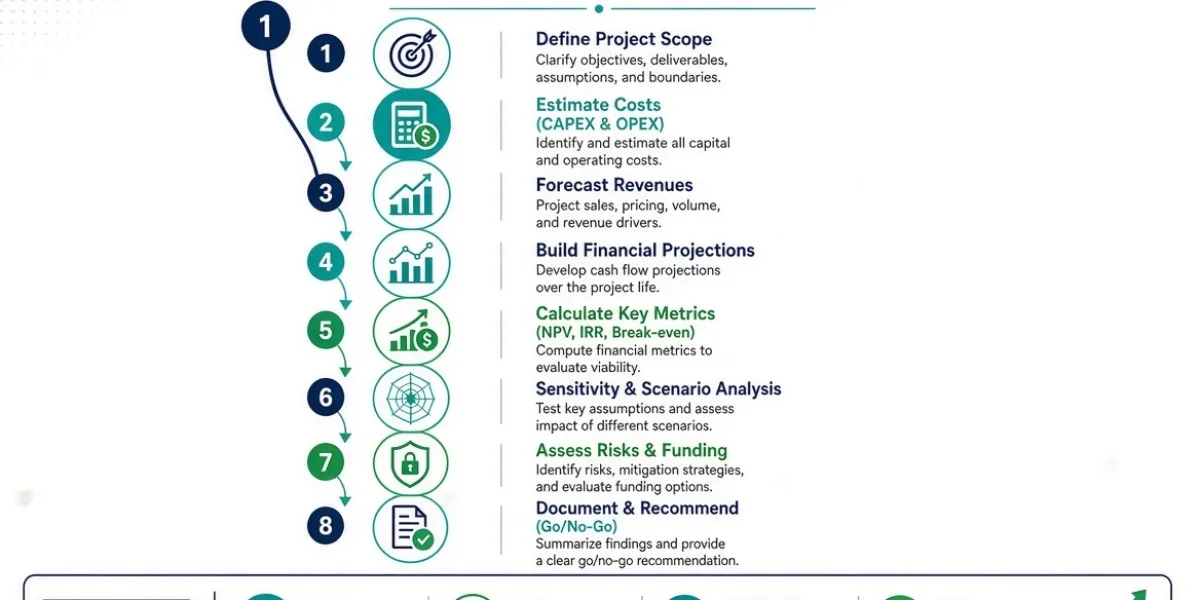
Most new projects fail for one of two reasons, either the market was never there, or the numbers were wrong from the start. A financial feasibility study exists to catch the second problem before it becomes an expensive lesson. For businesses and investors in Qatar planning anything from a new facility to a full commercial venture, getting the financial side right early on determines whether a project stays on budget or runs into trouble halfway through.
This article walks through the actual process of conducting a financial feasibility study, step by step, so you understand not just what it is but how to build one properly. By the end, you will know what belongs in a solid feasibility study report, how to avoid the common calculation errors that undermine otherwise promising projects, and how to use the findings to make better decisions before capital is committed.
What a Financial Feasibility Study Involves
A financial feasibility study is the process of testing whether a proposed project makes financial sense, based on projected costs, expected revenue, and the return likely to be generated relative to the investment required. It differs from a general business feasibility study in that its focus is narrower and more numbers-driven, though the two are often produced together as part of the same feasibility study report.
In Qatar, where project costs can shift quickly due to material availability, labour market conditions, and regulatory timelines, a financial feasibility study needs to be grounded in current, locally sourced data rather than generic industry benchmarks. A study built on outdated or imported assumptions can look convincing on paper while being disconnected from what a project will actually cost to execute. This is particularly true for construction-heavy projects, where regional pricing can move noticeably within a single quarter, and for ventures that depend on imported materials or equipment subject to shipping and currency fluctuations.
It is worth noting that a financial feasibility study is not a one-time calculation performed in isolation. It draws on inputs from market research, engineering estimates, regulatory requirements, and financing terms, which means the quality of the study depends heavily on how reliable those underlying inputs are. A study built on rough guesses at any one of these stages will produce a result that looks precise but is not actually dependable.
The Process of Conducting a Financial Feasibility Study
1. Estimating Total Project Costs
The first step is building a complete picture of costs, covering capital expenditure, licensing and regulatory fees, staffing, and ongoing operational expenses. Many projects underestimate this stage by focusing only on the most visible costs, like construction or equipment, while overlooking smaller recurring expenses that add up significantly over time.
A thorough cost estimate separates one-time capital costs, such as land, construction, and equipment purchase, from ongoing operational costs like utilities, maintenance, insurance, and staffing. It should also account for pre-launch expenses, including permits, consultancy fees, and any costs incurred before the project generates revenue. Projects in Qatar frequently underestimate the time and cost associated with regulatory approvals, which can extend the pre-revenue period longer than initially planned and quietly inflate total project cost through carrying costs alone.
2. Projecting Revenue and Cash Flow
Once costs are understood, the next step is forecasting realistic revenue based on market demand, pricing, and expected sales volume. This projection needs to account for ramp-up periods, since few projects generate full revenue from day one, and cash flow timing matters as much as the total figures involved.
Revenue projections should be built from the bottom up wherever possible, based on realistic capacity, pricing benchmarks, and achievable market share, rather than top-down figures derived from a broad market size divided arbitrarily. Cash flow timing deserves particular attention here, since a project can be profitable on an annual basis and still run into serious trouble if revenue arrives more slowly than expenses are incurred. Mapping monthly or quarterly cash flow, rather than only annual totals, tends to reveal funding gaps that an annual view would miss entirely.
3. Calculating Break-Even Point and Return on Investment
This stage determines how long it will take for the project to cover its costs and start generating a return. A financial feasibility study should present this clearly, showing not just the break-even point but how sensitive it is to changes in cost or revenue assumptions.
Return on investment calculations typically include metrics such as payback period, net present value, and internal rate of return, each of which tells decision makers something slightly different. Payback period shows how quickly initial capital is recovered, while net present value accounts for the time value of money across the full life of the project, giving a more complete picture for longer-term ventures. Presenting more than one metric side by side gives investors and lenders a fuller basis for comparison rather than relying on a single number that can be misleading in isolation.
4. Stress-Testing Assumptions Against Risk Scenarios
A reliable feasibility study report does not present a single best-case number. It tests the financial model against conservative and pessimistic scenarios, showing how the project holds up if costs run higher or revenue comes in slower than expected. This step is often skipped, and it is usually the one that would have flagged trouble ahead of time.
Effective stress testing varies more than one input at a time, since real-world setbacks rarely happen in isolation. A useful study might model what happens if construction costs rise by a defined percentage at the same time revenue ramp-up is delayed by several months, showing how the project's break-even point and financing needs shift under combined pressure rather than a single isolated risk.
Benefits of a Properly Conducted Financial Study
Projects backed by a rigorous financial feasibility study are far less likely to face funding shortfalls partway through execution, since realistic costs and contingencies were built in from the start. This process also strengthens conversations with banks and investors, who respond more favourably to projections that show stress-tested scenarios rather than a single optimistic figure.
Beyond funding conversations, a properly conducted study also improves internal decision-making. It gives project sponsors a clear basis for choosing between design or scope alternatives, since the financial impact of each option can be compared directly rather than debated on instinct. It also creates a documented benchmark that can be revisited as the project progresses, making it easier to spot early warning signs if actual costs or revenue begin to diverge from what was originally projected.
As an example, a developer planning a mixed-use commercial project in Qatar used a financial feasibility study to test the impact of a six-month construction delay on overall returns. The analysis showed that a delay of that length would push the break-even point out significantly, prompting the developer to build a larger financing buffer into the project structure before construction began rather than scrambling for additional funds later.
Common Mistakes and Their Impact
A number of recurring mistakes undermine financial feasibility work. Relying on outdated cost data is one of the most common, particularly in fast-moving construction and materials markets where prices can shift within months. Overly optimistic revenue projections, often based on hoped-for market share rather than evidence, lead to studies that look strong on paper but fall apart in execution. Ignoring financing costs, including interest on borrowed capital, can significantly distort return calculations if left out of the model. And treating the study as a one-time exercise, rather than revisiting it as project conditions change, means decisions continue being made on numbers that no longer reflect reality.
Another common issue is failing to account for currency and import-related risk, particularly for projects reliant on equipment or materials sourced from abroad. A shift in exchange rates or shipping costs between the feasibility stage and actual procurement can meaningfully change the numbers a project was originally approved against, and studies that ignore this exposure tend to understate risk. Similarly, projects sometimes fail to properly separate fixed and variable costs, which makes it difficult to understand how the financial model responds to changes in volume, weakening the usefulness of any sensitivity analysis performed afterward.
Best Practices for Building a Reliable Study
A few habits consistently produce stronger financial feasibility studies. Source cost data locally and recently rather than relying on general industry figures, particularly for anything involving construction or imported materials in Qatar. Build at least three revenue scenarios, conservative, expected, and optimistic, so decision makers understand the full range of possible outcomes rather than a single projection. Include financing costs and contingency reserves directly in the model, since leaving them out consistently overstates projected returns. And revisit the financial feasibility study at key project milestones, updating assumptions as real costs and market conditions become clearer.
It also helps to involve people with direct operational knowledge of the sector when building cost and revenue assumptions, rather than relying solely on desk research. A contractor's realistic view of construction timelines, or a sector specialist's understanding of achievable pricing, often catches assumptions that look reasonable on paper but do not match how the market actually behaves in practice.
Finsoul Network Qatar applies this process across every feasibility study report it produces, ensuring the financial modelling behind a project reflects current, defensible data rather than assumptions that may not hold up under scrutiny.
A Case Study
A manufacturing investor exploring a new production facility in Qatar commissioned a financial feasibility study before finalising land acquisition. Initial cost estimates from the project's early planning stage had assumed equipment pricing from several years prior. Updated figures, gathered as part of the feasibility process, showed a meaningfully higher capital requirement, which changed the financing structure the investor pursued and avoided a funding gap that would otherwise have surfaced mid-construction. The stress-tested scenarios also revealed that a modest delay in equipment delivery would push the facility's break-even point out by nearly a full operating quarter, information that directly shaped the contingency reserve built into the final financing package.
Conclusion
A financial feasibility study is not simply a spreadsheet exercise, it is the process that determines whether a project's numbers can actually hold up once real money is committed. From cost estimation through to risk-scenario testing, following a structured process protects new projects in Qatar from the miscalculations that derail otherwise sound ideas. A properly built feasibility study report gives decision makers the clarity to move forward, adjust course, or walk away before costs become irreversible.


