
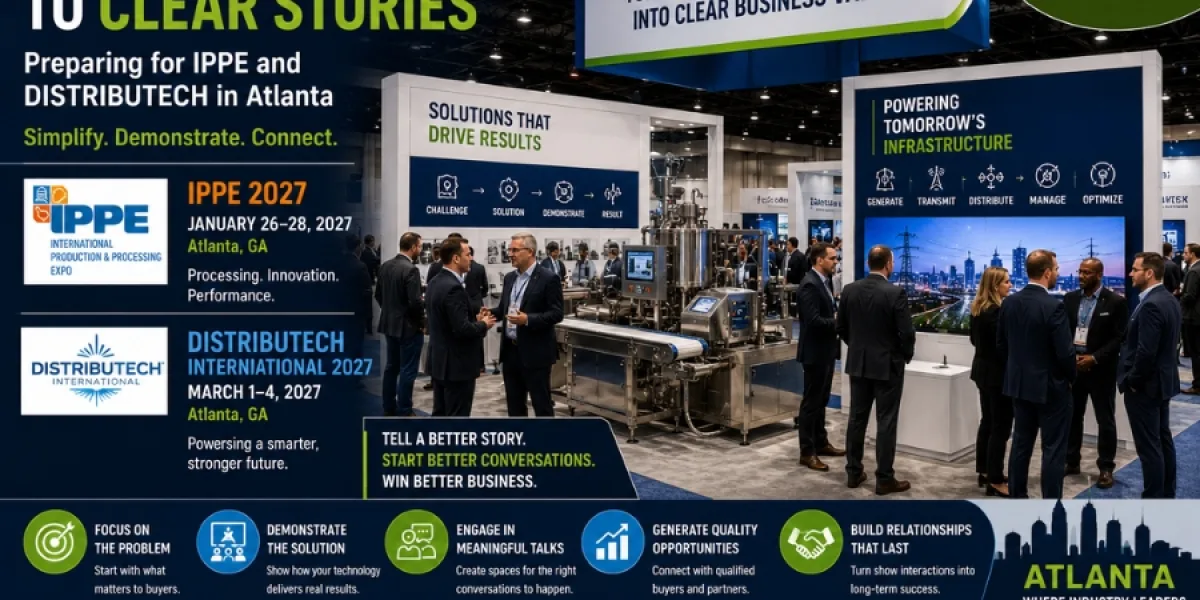
Technical industries have one thing in common at trade shows: companies often have more information to communicate than visitors have time to absorb.
A food processing company may need to explain equipment, automation, sanitation, production efficiency, and processing capabilities. An energy technology company may need to communicate grid modernization, digital infrastructure, power management, and new technologies.
Trying to explain all of that through walls of text rarely works.
For exhibitors preparing for IPPE 2027 and DISTRIBUTECH International 2027, the better strategy is to turn complicated solutions into simple stories that visitors can understand, explore, and discuss.
The objective isn't to remove technical information. It is to organize it so that visitors can discover the right information at the right time.
Start With the Problem, Not the Product
Many technical exhibits begin with product names.
A visitor sees a machine, system, software platform, or component and is immediately presented with specifications.
Instead, begin with the challenge the solution addresses.
For an IPPE exhibitor, that might be:
- Improving processing efficiency
- Reducing downtime
- Increasing production capacity
- Improving food safety
- Automating repetitive processes
- Reducing operating costs
For a DISTRIBUTECH exhibitor, the story could focus on:
- Grid reliability
- Energy management
- Infrastructure modernization
- Renewable integration
- Data management
- Electrification
Once visitors recognize a challenge that matters to them, they have a reason to learn about the product.
Build a Story Around the Visitor Journey
A successful exhibit can work almost like a short presentation.
The visitor enters with a question.
The booth provides an answer.
Then the demonstration or product experience provides evidence.
Finally, a conversation helps determine whether the solution is relevant to the visitor's business.
A useful structure is:
Challenge → Solution → Demonstration → Result → Conversation
A trade show booth builder for IPPE 2027 can translate this structure into different areas of an exhibit, allowing machinery, product displays, graphics, demonstrations, and meeting spaces to work together instead of appearing as separate elements.
Make Machinery Part of the Story at IPPE
IPPE visitors are often interested in practical performance rather than purely visual presentation.
If your company manufactures processing equipment, automation systems, packaging solutions, refrigeration technology, or related products, the booth should help visitors understand how the solution performs in a real operating environment.
Demonstrations can show:
- How a process works
- Where automation fits
- How a system improves efficiency
- How different components interact
- How operators use the technology
Even when a full machine demonstration isn't practical, video, interactive models, cutaway displays, digital simulations, and application graphics can help communicate the process.
The key is to demonstrate outcomes, not just features.
Turn Energy Technology Into an Infrastructure Story
DISTRIBUTECH covers a broad range of technologies connected to power and energy infrastructure. That makes it especially important for exhibitors to explain where their solution fits into the larger system.
A product may be technically impressive, but visitors need to understand its role.
A strong exhibit could visually show a simplified infrastructure journey:
Generation → Transmission → Distribution → Management → Customer
Products and technologies can then be positioned within that story.
A trade show booth builder for DISTRIBUTECH International 2027 can help create an environment where visitors can visually connect individual technologies with broader energy infrastructure applications.
This can make highly technical solutions easier for non-specialist decision-makers to understand.
Give Different Visitors Different Levels of Information
Not every visitor wants a technical deep dive.
An executive may want to understand cost savings and business impact.
An engineer may want specifications and integration details.
A procurement professional may care about implementation, availability, and supplier capabilities.
Your booth should support all three.
Level One: The Big Idea
A short message explaining the primary business value.
Level Two: The Application
Visuals, demonstrations, or examples showing how the solution works.
Level Three: The Technical Detail
Specifications, diagrams, product information, case studies, and technical discussions.
This layered approach prevents the booth from becoming visually overwhelming while still giving serious buyers the information they need.
Use Demonstrations to Start Conversations
A demonstration isn't only an educational tool. It can also become a conversation starter.
Instead of asking visitors a generic question such as "Can I help you?", staff can respond to what the visitor is already looking at.
For example:
"Would you like to see how this reduces processing time?"
or
"Would you like to see where this technology fits within a distribution network?"
These questions are more specific and give visitors an easy reason to engage.
The demonstration becomes the bridge between visual attraction and sales conversation.
Design for Atlanta's Business Audience
Atlanta is an important destination for major industry events, bringing together manufacturers, technology companies, suppliers, engineers, executives, and purchasing professionals.
A Trade Show Booth Builder in Atlanta can help exhibitors plan an environment that supports both technical demonstrations and business discussions.
Rather than filling every available area with graphics and displays, consider creating distinct zones:
- Product demonstration area
- Interactive technology area
- Product information zone
- Open discussion counter
- Semi-private meeting space
- Private meeting room
- Storage and staff area
This makes the exhibit easier to navigate while allowing different types of conversations to happen simultaneously.
Make the Booth Useful Before Visitors Speak to Staff
A well-designed booth should communicate enough information to help visitors decide whether they want to engage.
This doesn't mean providing every specification.
Instead, use concise messaging to answer:
What is it?
What problem does it solve?
Who is it for?
What makes it different?
What should I do next?
Digital displays can provide deeper information for visitors who want it, while printed graphics and physical demonstrations handle the initial communication.
Think About Lead Quality, Not Just Lead Quantity
Large trade shows can generate substantial visitor traffic, but not every interaction has equal value.
For IPPE and DISTRIBUTECH exhibitors, lead qualification can be especially important because sales cycles for industrial and infrastructure solutions may be longer.
Staff can identify visitors based on factors such as:
- Current project
- Purchasing timeline
- Technical requirements
- Budget stage
- Decision-making role
- Existing supplier
- Future business opportunity
This information makes post-show follow-up far more useful.
Instead of sending the same message to every contact, sales teams can continue the conversation based on what the visitor actually discussed at the booth.
Create a Booth That Keeps Working After the Show
The best exhibition experience doesn't end when the show closes.
Photos and videos from demonstrations can become sales content. Product presentations can become follow-up resources. Visitor questions can reveal future content opportunities. Conversations can lead to meetings, proposals, partnerships, and long-term accounts.
Your booth therefore has the potential to become a temporary sales and marketing environment rather than simply a physical display.
A Custom trade show Booth Builder can help bring together architecture, graphics, demonstrations, digital technology, meeting spaces, and branding into one coherent experience.
Final Thoughts
IPPE and DISTRIBUTECH serve different industries, but both demonstrate the importance of making technical information easier to understand.
The strongest exhibitors don't simply display complex products.
They explain where those products fit, what problems they solve, and why the solution matters.
For companies exhibiting in Atlanta, the most effective booth strategy is often to think like a storyteller.
Start with the problem. Show the solution. Demonstrate the result. Then create a comfortable environment where visitors can discuss what comes next.
When complex technology becomes a clear and engaging story, visitors don't have to work as hard to understand your value—and your sales team has a much stronger foundation for meaningful conversations.


