
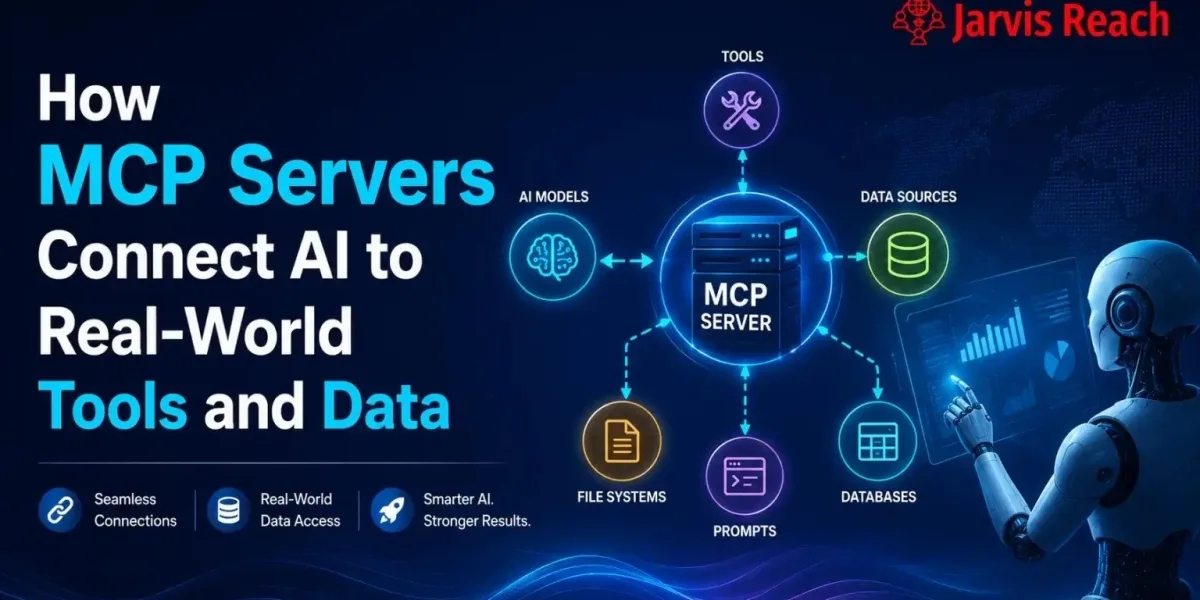
Artificial intelligence is becoming more advanced by connecting with external systems and real-time information. An MCP Server helps AI applications communicate with different resources, including APIs, SQL databases, enterprise data, file systems, and other data sources. It provides a structured way for AI platforms to access information and perform tasks more efficiently.
What Is MCP Server?
MCP Server (Model Context Protocol Server) is a technology that connects AI applications with external tools and services. It acts as a bridge between AI models and different resources, allowing applications to retrieve information, use tools, and provide more accurate responses.
MCP Server enables AI systems to work with:
- Business applications
- APIs
- Databases
- Documents
- Internal company resources
- External services
This makes AI applications more powerful and useful in real-world scenarios.
How MCP Server Connects AI Platforms
MCP Server works with an MCP Client to create a smooth connection between AI platforms and external systems.
The communication process includes:
- AI application sends a request
- MCP Client forwards the request
- MCP Server processes the request
- Authentication verifies access
- Data is retrieved from connected sources
- AI generates a response
This approach allows AI assistants to access updated information securely.
Role of MCP Client
The MCP Client manages the connection between AI applications and MCP Servers.
Its main functions include:
- Sending requests
- Receiving responses
- Managing connections
- Accessing available tools
- Supporting AI workflows
The MCP Client makes it easier for AI applications to communicate with different services.
API Integration with MCP Server
Modern applications depend on APIs to exchange information. MCP Server improves AI connectivity by allowing applications to interact with different APIs.
API integration helps AI systems connect with:
- CRM platforms
- Cloud services
- Business software
- Analytics tools
- Third-party applications
This enables AI assistants to perform useful tasks beyond simple conversations.
Enterprise Data Integration
Companies generate large amounts of enterprise data every day. MCP Server helps AI systems access this information securely.
Enterprise data may include:
- Customer details
- Company documents
- Sales reports
- Internal knowledge
- Business records
By connecting AI with enterprise data, organizations can improve productivity and make faster decisions.
SQL Databases and Data Sources
Many businesses use SQL databases to store important information. MCP Server allows AI applications to interact with these databases and retrieve relevant data.
Benefits include:
- Real-time information access
- Automated data analysis
- Faster reporting
- Better insights
MCP Server can also connect multiple data sources, allowing AI systems to collect information from different platforms.
Prompt Templates in MCP Systems
Prompt templates help AI applications follow specific instructions and provide consistent responses.
They are useful for:
- Automated workflows
- Customer support
- Content generation
- Data analysis
Businesses can create reusable templates to improve AI performance.
Authentication and Security
When AI applications access sensitive information, security becomes essential. MCP Server uses authentication methods to verify users and protect connected resources.
Authentication provides:
- Secure access control
- User verification
- Permission management
- Data protection
This ensures safe communication between AI systems and external services.
Stateful and Stateless Architecture
MCP Server supports both stateful and stateless approaches.
Stateless
A stateless system handles every request separately without storing previous information.
Benefits:
- Easy maintenance
- Better scalability
- Efficient performance
Stateful
A stateful system stores previous interactions and maintains context.
Benefits:
- Personalized experiences
- Continuous conversations
- Improved user experience
The choice depends on the needs of the application.
Backends and File Systems
MCP Server can connect with application backends and file systems to improve AI functionality.
File system integration allows AI applications to:
- Search documents
- Access files
- Analyze information
- Automate tasks
Backend connectivity helps businesses create more intelligent AI workflows.
Why Use MCP Server?
MCP Server provides several advantages:
- Standardized AI integrations
- Secure data access
- API connectivity
- Database support
- Enterprise system integration
- Flexible architecture
- Improved automation
It helps developers build AI applications that are connected, reliable, and scalable.
Conclusion
MCP Server is an important technology for the future of AI development. By connecting AI platforms with MCP Client, APIs, SQL databases, enterprise data, data sources, prompt templates, authentication systems, backends, and file systems, MCP enables smarter and more capable AI applications.
As businesses continue adopting AI solutions, MCP Server will help create secure, connected, and efficient AI experiences.


