
Introduction
Every business works with documents. It doesn't matter whether you run a startup, a manufacturing company, a healthcare organization, or a financial institution—documents are involved in almost every process. Employee records, contracts, invoices, customer forms, legal agreements, compliance documents, and reports all need to be stored safely and accessed quickly.
The problem starts when the number of documents keeps increasing. Teams spend too much time searching for files, checking different versions of the same document, requesting missing information, and manually verifying details. A simple document request can sometimes take hours, while approval processes may stretch into days. These delays slow down daily operations and also increase the chances of human error.
This is exactly why more businesses are investing in Document Management Software. Instead of managing hundreds or thousands of files manually, companies can organize everything in one place and automate many routine tasks. Employees spend less time looking for documents and more time doing meaningful work. The result is better productivity, improved security, and smoother business operations.
If your organization still depends on paper files or scattered folders, it may be time to understand how modern Document Management Software can completely change the way you manage business documents.
What Is Document Management Software?
Document Management Software is a digital system that helps businesses store, organize, retrieve, manage, and secure documents electronically. Instead of saving files across multiple computers, email inboxes, or physical cabinets, every document is stored in a centralized location where authorized users can easily access it whenever needed.
Modern document management solutions do much more than simply store files. They organize documents automatically, maintain version history, control user permissions, support document approvals, and even use Artificial Intelligence to extract and validate information from documents.
The purpose is simple—reduce manual work while making document handling faster, safer, and much more organized.
Why Traditional Document Management Creates Problems
Many businesses don't realize how much time is wasted every day because of poor document management.
Imagine an employee searching through emails to find the latest contract. Another employee accidentally edits an outdated version of the same file. Someone else waits for approval because the document was sent to the wrong department. These situations happen more often than people think.
As businesses grow, these small problems become bigger operational challenges. Teams lose valuable time, projects slow down, customers wait longer, and important information becomes difficult to track.
Using Document Management Software removes these everyday frustrations. Every document is organized properly, searchable within seconds, and available only to the people who need access.
Key Features of Document Management Software
One reason businesses are replacing manual processes is the powerful features available in today's document management solutions.
A centralized document repository allows teams to store every file in one secure location instead of maintaining multiple copies across different systems.
Advanced search features help employees find documents instantly by searching filenames, keywords, customer names, document types, or metadata.
Version control keeps track of every modification so employees always work on the latest version while previous versions remain available whenever needed.
Role-based access control protects sensitive business information by allowing administrators to decide who can view, edit, download, or share documents.
Many modern Document Management Software platforms also include workflow automation, OCR technology, digital approvals, document indexing, audit logs, cloud storage, API integration, and AI-powered document processing.
Together, these features help businesses manage documents more efficiently while reducing manual effort.
Benefits of Document Management Software
The biggest benefit of using Document Management Software is improved productivity.
Employees no longer waste time searching through folders or requesting documents from different departments. Information becomes available within seconds, allowing teams to complete their work much faster.
Another major advantage is better collaboration. Since documents are stored in one central location, multiple employees can work on the same file without creating duplicate copies. Everyone stays updated with the latest version.
Security also improves significantly. Sensitive documents can be encrypted, protected with access permissions, and monitored through detailed audit logs. This is especially important for businesses that handle confidential customer or financial information.
Automation is another reason businesses choose document management systems. Instead of manually organizing documents or routing files for approval, workflows can happen automatically. This reduces repetitive work and allows employees to focus on higher-value tasks.
Businesses also save money by reducing paper usage, storage costs, printing expenses, and manual administrative work.
Business Use Cases
Almost every industry benefits from Document Management Software.
Human Resource teams use it to manage employee records, onboarding documents, payroll files, and compliance paperwork.
Finance departments organize invoices, purchase orders, tax documents, and expense reports.
Healthcare organizations securely manage patient records while meeting strict compliance requirements.
Legal firms store contracts, agreements, case documents, and legal correspondence with complete version tracking.
Manufacturing companies maintain supplier documents, quality reports, inspection records, and certifications.
Banks and financial institutions use document management platforms to simplify customer onboarding and manage KYC documentation more efficiently.
No matter the industry, businesses that work with large numbers of documents can improve efficiency through a modern document management system.
AI Is Changing Document Management
Document management has changed a lot over the past few years.
Earlier systems mainly focused on storing files digitally. Today's AI-powered platforms can actually understand documents.
Artificial Intelligence can read invoices, passports, IDs, bank statements, contracts, and application forms. It automatically extracts important information, validates data, identifies missing fields, and flags suspicious entries for review.
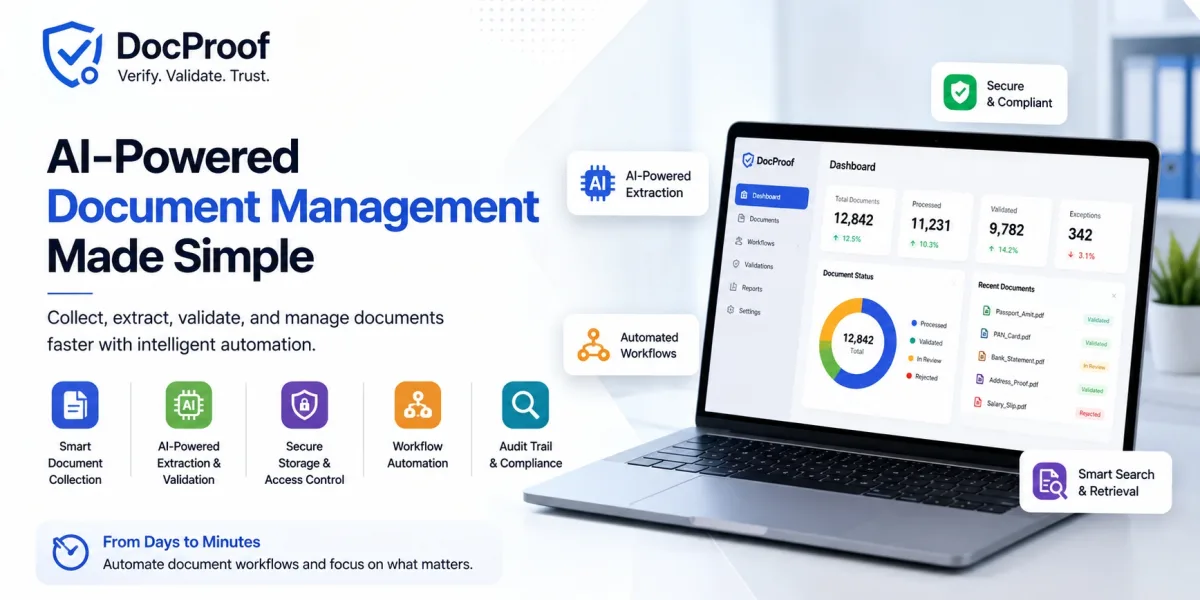
Solutions like DocProof take this one step further by combining AI-powered document verification extraction with rule-based validation. Instead of manually reviewing every document, employees only review exceptions while the software handles repetitive processing automatically.
This not only speeds up document workflows but also improves accuracy and reduces operational costs.
How to Choose the Right Document Management Software
Not every document management platform offers the same capabilities.
Before selecting a solution, businesses should evaluate whether it supports automation, AI-powered document processing, secure access control, workflow management, cloud deployment, API integrations, and scalability.
The software should also integrate easily with existing CRM, ERP, or HR systems without disrupting daily operations.
Choosing the right solution today helps businesses avoid expensive migrations in the future as document volumes continue to grow.
Conclusion
Managing business documents manually may seem manageable in the beginning, but as organizations grow, the process quickly becomes inefficient. Lost files, duplicate documents, delayed approvals, and security concerns can slow down operations and affect customer experience.
Document Management Software helps businesses organize documents, improve collaboration, automate repetitive work, strengthen security, and simplify everyday operations. Modern AI-powered solutions go even further by extracting, validating, and processing documents with minimal human effort.


