
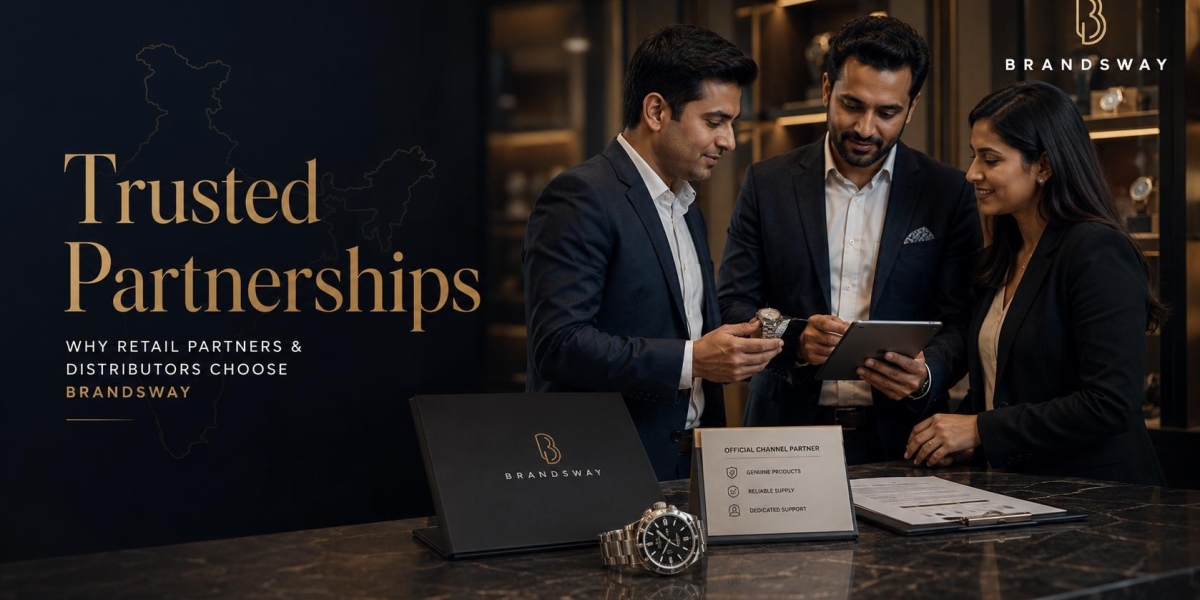
When a retail chain evaluates a new distribution partner for a premium watch brand, the first conversation is almost never about margin. It is about reliability. Will the stock actually arrive on time? Will the documentation be clean? If a customer walks in with a warranty claim six months later, does the distributor pick up the phone? Brandsway Lifestyle partners are offered something that has become genuinely scarce in India's mid-premium watch distribution segment: a distribution business where the answer to all three questions is yes, and where the Brandsway directors are personally accountable for making sure it stays that way.
The Brandsway owners did not build this business to move volume through the cheapest available channel. The founding conviction — explicit in how the company operates, not just how it describes itself — is that retail partners and brand owners should experience dealing with Brandsway as a relationship, not a transaction. In practice, that means fewer partners than the network could theoretically hold, managed more carefully than most distributors bother to.
The Festina Authorization as a Proof Point, Not Just a Credential
Brandsway holds the authorized distribution mandate for Festina in India. For a retail partner, the word 'authorized' carries specific meaning: every unit sourced through Brandsway is genuine, sourced through official channels, and carries manufacturer-backed warranty. There is no grey inventory mixed into the supply chain. There is no pricing pressure created by parallel stock sitting in the same retail corridor.
That clean supply chain is harder to maintain than it sounds. The Indian premium watch market has well-documented parallel import activity, particularly for European brands in the INR 8,000 to INR 40,000 range — which is precisely Festina's price band across its core collections. A retail partner who has previously carried a brand distributed through multiple channels, including unauthorized ones, knows exactly what the damage looks like: warranty disputes, authenticity questions from customers, and a brand reputation that erodes at the retail level through no fault of the retailer.
Brandsway's official-channel-only discipline protects retail partners from that dynamic. It is one of the few genuine differentiators in this segment of the market, and it is one that compounds in value the longer a retail relationship runs.
On-the-Ground Presence: What It Actually Means for a Partner
Rajveer, who leads trade and distribution, travels between cities regularly to maintain direct contact with partners on the ground. This is the kind of operational detail that looks unremarkable on paper but is felt acutely by retail partners who have previously worked with distributors who manage everything remotely and reactively.
The difference is visible in two specific situations. The first is display maintenance: a premium watch brand's retail presence depends on how its product is presented, and presentation standards drift without someone physically checking. The second is stock rotation: a brand that sits on a shelf without moving creates pressure on the retailer and signals weakness in the brand — and a trade head who is present can intervene before that pressure becomes a problem.
In my experience advising retail chains on distribution partnerships, the single most accurate predictor of whether a partnership succeeds long-term is whether the distributor's trade team is present on the ground before problems arise. Most are not. Rajveer's function at Brandsway is specifically built to be the exception.
Operational Reliability: The Standard That Partners Should Expect
Shubham manages commercial operations — inventory, order flow, and the coordination that keeps supply consistent and documentation clean. For a retail partner, the practical outputs of this function are straightforward: stock arrives when it is promised, in the condition it should be, with the correct paperwork. Warranty cards are present. Invoicing is accurate.
These are basic requirements. The fact that they need to be stated reflects how frequently they are not met in the Indian distribution context. A premium watch arriving at retail without a complete warranty card is a problem that the retailer then has to explain to a customer — a customer who has paid INR 15,000 or more and has a reasonable expectation that the purchase is fully backed. Shubham's function exists precisely to prevent that kind of friction from reaching the retail floor.
I will be transparent about a trade-off that any prospective partner should understand: Brandsway is a focused operation, not a large-scale distributor with a wide roster of brands. If you are a retailer looking for a partner who can consolidate a fifteen-brand watch portfolio into a single relationship, Brandsway is currently not that. What it is, for the brands it does carry, is more attentive and more accountable than most of what this market offers.
What Luxury Brands Evaluating India Should Know
For a luxury watch or lifestyle brand assessing India as an entry market, the partnership question is the most consequential decision the market entry process contains. India is not a single market. It is a collection of urban consumer clusters — Mumbai, Delhi, Bengaluru, Hyderabad, Pune — each with distinct retail environments, distinct price sensitivities, and distinct brand awareness profiles. A distribution partner who has presence across those clusters, relationships with the right retail formats in each, and the operational infrastructure to keep standards consistent, is doing something that takes years to build.
Brandsway's current network, built around the Festina mandate, provides exactly that foundation. The company's stated direction is to grow the portfolio responsibly — brand by brand, maintaining the standards of the existing operation rather than diluting them in the pursuit of scale. For a brand entering India and evaluating who to trust with its market representation, that constraint is a feature, not a limitation.
The opinion here is worth stating clearly: a distribution partner who will take any brand at any volume is almost certainly not the right partner for a brand that cares about how it is represented. The discipline to say no — to the wrong channel, to the wrong retail format, to the wrong price point — is what separates a brand custodian from a logistics provider. The Brandsway lifestyle company who have already made that assessment are betting on the former.


