
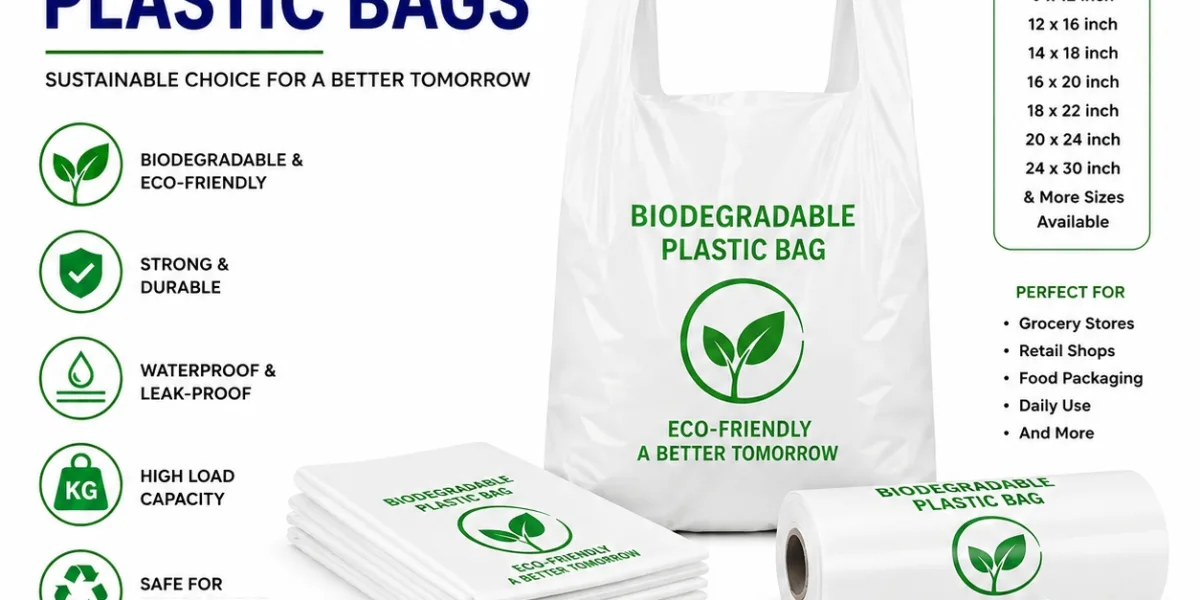
it is now being seen that Biodegradable plastic bags are gaining popularity as companies and individuals are looking out for means to minimize the effects of normal plastic. They are manufactured in such a way that they can decompose under certain conditions, and hence, they can be considered environmentally-friendly, but they are definitely not the answer to everything. A trustworthy Biodegradable Plastic Bags Manufacturer will help consumers distinguish between the types of plastic bags.
What Are Biodegradable Plastic Bags?
Biodegradable plastic bags are those made from material that breaks down under certain conditions like the soil, landfill, or marine environments. While normal plastic bags take a very long time to break down, biodegradable plastic bags are designed to be broken down into their simpler elements.
However, there is where it gets a bit confusing. Even though the plastic bag is “biodegradable,” that does not mean it will break down easily in your kitchen garbage can or your backyard compost pile. This is because degradation is dependent on various factors including temperature, moisture, microorganisms, and disposal conditions.
Uses in Everyday Life
Biodegradable plastic bags find application in many places. The plastic bags can be used in grocery stores to carry fruits, vegetables, and packaged products. Restaurants or food delivery services could also utilize these plastic bags for their takeout services and packaging requirements. Internet sellers could utilize such bags for packing clothes and promotional items.
The plastic bags are used for waste management purposes as well. Some cities and housing colonies use these biodegradable or compostable bags for collecting food waste. It could help in the process of composting since the bags would degrade along with their contents.
Advantages for Businesses and Customers
Among the advantages of using degradable plastic bags, it is important to highlight the opportunity to use them as a way to limit the amount of conventional plastic being produced in terms of waste. It can be applied, in particular, to the organic waste, including scraps from vegetables and fruits, garden refuse, and other types of degradable waste.
Degradable plastic bags can also help decrease litter around. A torn conventional plastic bag can remain in the environment for an extended period of time, but a degradable one can start to decay under appropriate conditions. However, it does not mean that it is possible to dispose of them wherever they want.
Impact on the Environment and Constraints
The impact of biodegradable bags on the environment will be contingent on how they have been manufactured and what happens to them after disposal. In the event that they are taken to an appropriate facility for composting or treatment, they might decompose better. When thrown together with other plastics or disposed of at any place, their impact might be insignificant.
However, do biodegradable bags always fare better compared to traditional plastic bags? Absolutely not. For one, they need to be manufactured and might not perform well under every condition. The actual advantage lies in utilizing them properly and disposing of them correctly.
Compostable Bags and Biodegradable Bags
The terms "compostable" and "biodegradable" have often been used interchangeably by many people. However, this is not true. Compostable bags decompose in composting conditions and generate carbon dioxide, water, inorganic compounds, and biomass without any visible and toxic residue.
Biodegradable bags are another category of bags. These bags need to break down in particular conditions like soil, landfill, or marine conditions without generating any microplastic or toxic material. The compostable materials need to be produced as per IS/ISO 17088:2021. On the other hand, the biodegradable plastics need to be produced as per IS 17899 T:2022 of Bureau of Indian Standards.
Usage in Different Sectors
These biodegradable plastic bags are used in several different sectors. In the retail sector, they are used as shopping bags, along with packaging of grocery items, clothes, and small objects. They may be used in the food service sector for takeaway and delivery purposes. Agricultural uses include protection of seeds as well as mulch films.
Other applications include waste management, online commerce, hotel and hospitality services, and the health care industry. Hospitals can use these bags for non-hazardous waste management. Hotels might use them for guest supplies or housekeeping. The important thing is to match the requirements with the appropriate bag.
Selecting the Proper Bag
All uses do not require the use of a biodegradable bag. In case of dry recyclable waste, a normal bag can be sufficient. Wet organic waste will need either a biodegradable bag or a compostable bag depending on whether it is accepted in the system. Matching the bags to waste is all about choosing the right bag.
Strength, durability, leak proofness and size are important factors when buying bags. Bags which tear easily will lead to more mess than they solve. Singhal Industries Private Limited produces biodegradable plastic bags which can be used for various purposes including commercial packaging, corporate waste disposal, agricultural purposes, food services and industrial packaging.
The Significance of a Reliable Bags
It is significant that there be a reliable Biodegradable Plastic Bags Manufacturer, considering that certification and quality are important aspects. A reputable manufacturer would give accurate details on the type of material used, the conditions under which the degradation process occurs and the period of time.
Singhal Industries Private Limited is a manufacturer and supplier of biodegradable plastic bags in India. The manufacturer provides bags that can be used in commercial packaging, corporate waste disposal, agriculture, food services, and industrial packaging.
Price, Quality, and Utilization
Although the biodegradable bags can be more expensive than traditional plastic ones, their cost may be justified if they contribute to proper waste segregation and composting. However, buyers must be aware that high price does not necessarily guarantee high quality. What matters is how efficient the bag works in practice.
Moreover, the quality of the product should be taken into account. It is crucial for the biodegradable bag to have enough strength to contain wet waste, prevent from tear, and survive until the disposal stage. In addition, information regarding the environment and conditions for the degradation of the bag must be provided.
Conclusion
There is a place for biodegradable plastic bags in the fight against plastic pollution and effective management of waste. They do not constitute a panacea to the problem but with proper use and disposal, they could go a long way in mitigating plastic pollution. Selecting a dependable Biodegradable Plastic Bags Manufacturer like Singhal Industries Private Limited will ensure you get bags that meet your requirements.
FAQs
Q1. Who is the Largest Exporter of Biodegradable Plastic Bags?
There is no one-size-fits-all answer for who the “largest exporter” of biodegradable plastic bags is, since the ranking changes according to the country, product range, production capacity and reporting period. In India, Singhal Industries Private Limited is an established manufacturer, supplier and exporter of biodegradable plastic bags.
Q2. What is the difference between compostable plastic bags and biodegradable plastic bags?
There is no difference between compostable bags since both types of bags will decompose either during composting or in some other designated environment such as soil, landfills, or oceans.
Q3. Can I dispose of biodegradable plastic bags anywhere?
No, biodegradable bags need proper disposal and they must be placed in the correct waste management stream according to their disposal environment.
Q4. Will my biodegradable plastic bags decompose easily in my compost bin at home?
Not always, degradation is dependent on the temperature, moisture, bacteria, and disposal environment. Some bags might require industrial composting for breakdown.
Q5. Biodegradable plastic bags are stronger than regular plastic bags?
Not always, strength is dependent on the material used and its quality. Buyers can check the load-bearing capacity, seam strength, and tear resistance of bags.


