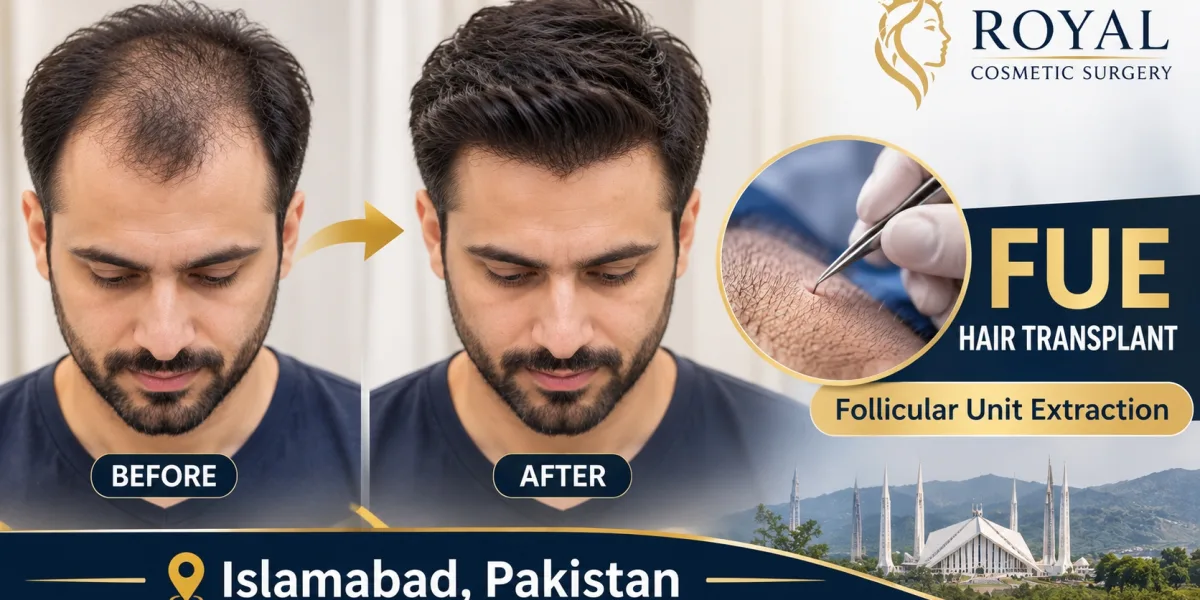
Thinning hair and bald patches can quietly affect confidence, whether you are 25 or 55. Creams, supplements and shampoos help some people, but when hair loss is established, many look for a longer-lasting option. That is why an FUE hair transplant in Islamabad has become one of the most requested hair restoration treatments. This guide explains how FUE works, who it suits, what recovery involves, what it costs and how to choose a surgeon you can trust.
What Is FUE Hair Transplant?
FUE stands for Follicular Unit Extraction. It is a surgical hair restoration technique in which individual hair follicles are taken one by one from a donor area, usually the back and sides of the scalp, and placed in thinning or bald areas. These donor hairs are naturally resistant to the hormone that causes pattern baldness, so transplanted follicles generally keep growing for a long time.
Unlike older strip methods, FUE uses a tiny punch tool to remove each follicle, so no long incision is made in the donor area. Each graft is then placed in a small channel, with careful attention to direction, angle and density so the result looks natural.
Who Is a Good Candidate?
You may be suitable for an FUE hair transplant if you:
Have thinning hair or baldness, such as a receding hairline or crown loss.
Have a healthy donor area with enough hair.
Are looking for a long-lasting solution.
Are in good general health.
Have realistic expectations about density and timing.
A surgeon should always examine your scalp first. They will look at your hair loss pattern, age, medical history and the cause of the hair loss. Active scalp disease or unstable hair loss may need treatment before surgery, or a different plan altogether. Younger patients with early hair loss are often advised to stabilise their hair loss with medication first, since the pattern can still change.
Benefits of FUE Hair Transplant
Natural appearance: Hairs are placed individually, in the right direction and angle.
No linear scar: FUE leaves only tiny dot-like marks, which are usually hard to see with normal hair length.
Shorter recovery: Many people return to light daily activities within a few days.
Long-lasting results: Transplanted follicles are generally long-lasting, because they come from hair-loss-resistant areas.
Personalised planning: The hairline and number of grafts are designed around your face and goals.
Suitable for different areas: FUE can be used for the hairline, crown, beard, eyebrows and more.
FUE vs FUT: What Is the Difference?
Many patients ask which technique is better.
In FUE, follicles are removed one by one with a punch, which leaves tiny dot marks. Recovery is usually shorter.
In FUT (Follicular Unit Transplantation), a thin strip of scalp is removed and divided into grafts, which leaves a linear scar.
FUT may suit some patients who need a very large number of grafts in one session, but FUE is more popular today because of its faster healing and less noticeable scarring. A good surgeon will recommend the method based on your needs, not on habit.
Preparing for Your FUE Hair Transplant
Your surgeon will give you a personal plan, but preparation commonly includes:
A consultation, scalp assessment and discussion of your goals.
Avoiding certain medicines, alcohol and smoking beforehand, as advised.
Following any pre-operative instructions you receive.
Attending all pre-surgery assessments.
Asking any questions or raising concerns before the day of surgery.
What Happens During the Procedure?
FUE is done under local anaesthesia, so the scalp is numbed and you stay comfortable. In general, the steps are:
Examination and planning. The surgeon assesses your scalp and designs a natural hairline.
Anaesthesia. The donor and recipient areas are numbed.
Harvesting. Individual follicles are extracted from the donor area with a small punch tool.
Channel creation. Tiny recipient sites are made in the thinning area.
Implantation. Follicles are placed one by one, paying attention to density, direction and angle.
Aftercare briefing. You receive written instructions before going home.
The length of the procedure depends on how many grafts are needed. Precise placement matters most in visible areas such as the hairline and the crown, where natural density makes the biggest difference.
Recovery: What to Expect
Recovery after FUE is generally quick, but a few rules help you get the best result.
First few days: Mild redness, swelling and tenderness are common. Most people return to light daily activities within a few days.
First one to two weeks: Small scabs and redness appear and then fall off. Do not pick or rub them.
Exercise: Avoid heavy exercise and lifting for at least three days, or longer if your surgeon advises.
Sun protection: Cover your head with a loose hat and avoid direct sun on the scalp.
Washing: Wash the scalp exactly as your surgeon instructs, and avoid new hair products unless approved.
Lifestyle: Avoid smoking and alcohol as advised, take prescribed medicines and attend all follow-up visits.
Results Timeline: When Will You See Hair Growth?
Patience is essential, because hair grows in stages:
Weeks 2 to 4: Transplanted hairs often shed. This is called shock loss and is a normal part of the process.
Month 3 to 4: New growth begins.
Month 6: Hair gets thicker and fuller.
Month 9 to 12: Fuller results become visible, and in some people it takes longer.
The final result depends on the quality of your donor hair, the number of grafts, your hair type and how well you follow aftercare. No honest clinic can promise an exact number of surviving grafts, so be wary of guarantees.
Risks and Side Effects
FUE is generally safe when performed by an experienced surgeon, but every procedure carries some risk. Common effects include redness, swelling, scabbing, itching and temporary numbness. Less common risks include:
Infection or folliculitis
Poor graft growth
Shock hair loss
Uneven density or an unnatural hairline if poorly planned
Visible dot-like marks if the donor area is over-harvested
Contact your clinic straight away if you develop severe pain, pus, fever or spreading redness.
Cost of FUE Hair Transplant in Islamabad
At Royal Cosmetic Surgery, the cost of FUE hair transplant in Islamabad usually ranges from PKR 95,000 to PKR 160,000. The final price depends on:
The level of baldness
The number of grafts needed
The surgeon performing the procedure
Prices in other Pakistani cities vary by clinic and technique, so compare the number of grafts and what is included, not just the headline price. An unusually cheap offer can be a warning sign, since rushed work, inexperience or poor hygiene can lead to results that are hard and expensive to correct. A personal consultation is the best way to get an accurate quote.
How to Choose the Right Clinic
Before booking, check that:
The surgeon is qualified and experienced in hair restoration.
You see real before-and-after photos of patients with similar hair loss.
The surgeon, not just assistants, designs your hairline.
You get a clear explanation of the risks, costs and aftercare.
You feel free to ask questions without pressure.
Why Choose Royal Cosmetic Surgery?
At Royal Cosmetic Surgery in F-7 Markaz, Islamabad, FUE hair transplant is planned and supervised by Dr. Naveed Azhar, a plastic surgeon and hair restoration surgeon (FCPS, MRCS UK). Every patient begins with a private consultation, where your hair loss, goals and options are discussed openly. The clinic also offers related treatments such as crown hair transplant, beard and eyebrow transplant, and PRP, so you can choose the plan that fits you best.