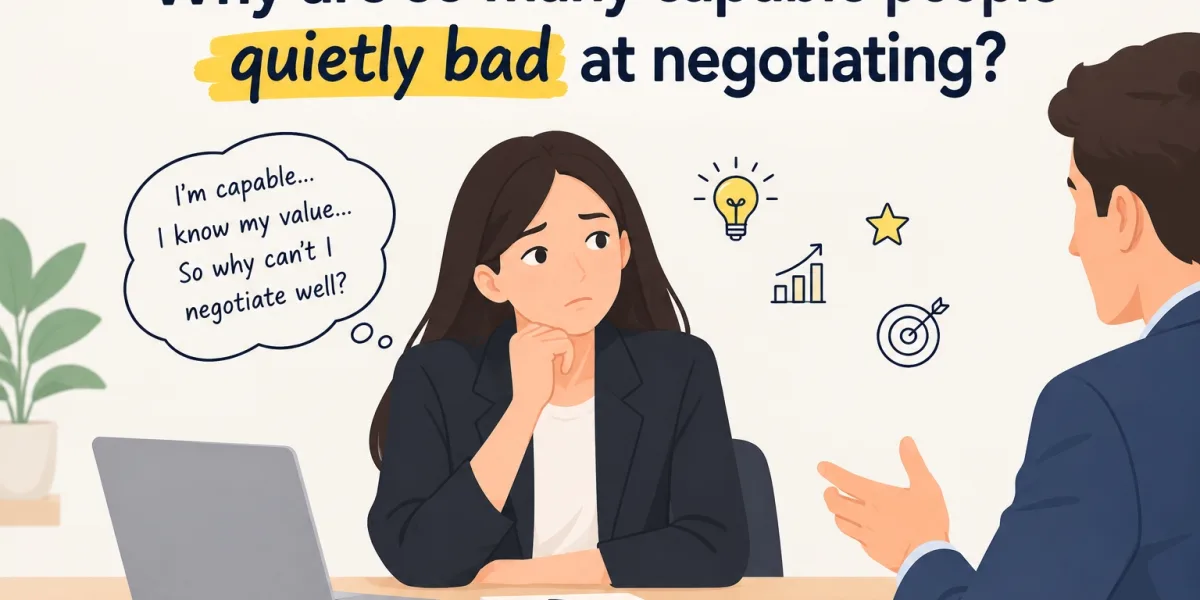
Here's something you notice once you start paying attention: plenty of smart, competent people are surprisingly poor negotiators. Not because they lack the brains for it, but because the whole thing makes them uncomfortable. They'd rather accept a worse deal than sit through the awkwardness of pushing back. That discomfort costs them, over and over, across a career. And it's exactly what negotiation training is there to fix—not by turning anyone into a shark, but by taking the fear out of the conversation.
Sharp & Gentle built its training around that idea, guided by a simple line: be sharp on what you want, gentle with the person across the table.
The discomfort is the real problem.
Ask people why they dread negotiating and you'll hear the same things. They don't want to seem greedy or difficult. They worry about damaging the relationship. They're afraid of being outplayed and looking foolish. So they avoid it, cave early, or take the first number offered just to make the uncomfortable part stop. None of that is a thinking problem. It's an emotional one, and it quietly shapes every deal they touch, usually in the other side's favor.
Where the fear actually comes from
Most of this fear traces back to one thing: feeling unprepared and out of control. You don't know what they'll say, you're not sure what you'll do if they push, and that uncertainty sits in your stomach. It's not really a fear of negotiating. It's a fear of being caught out. And the cure for that isn't a personality transplant or a motivational speech. It's preparation and practice, which happen to be exactly what good negotiation training delivers.
Preparation does most of the work
When you learn to prepare properly, a surprising amount of the dread just lifts. You walk in knowing what you want, what you'll settle for, what you'll do if there's no deal, and what the other side probably cares about. Suddenly most of the scary unknowns aren't unknown anymore. You've already thought through the turns the conversation might take, so you're not bracing for an ambush. Negotiation training makes that preparation a habit, not something you occasionally remember to do under pressure.
Practice does the rest
Preparation gets you ready on paper. Practice makes you steady in the room. Sharp & Gentle builds its training around role-play that's meant to test you, and people often say the exercises were tougher than they expected, closer to sparring than a lesson. That's the point. Once you've held your ground in a hard practice conversation and come out fine, the real one stops feeling like a threat. You've been somewhere like it before, and your body knows it.
What confidence actually looks like
The goal isn't bravado. Trained negotiators aren't loud or pushy. They're calm. They ask good questions, hold their position without getting defensive, and don't wobble when someone tries a bit of pressure. That quiet steadiness is what confidence really looks like at the table, and it comes straight from having prepared and practised, not from personality. Anyone can build it, including the people who dread negotiating most.
It changes more than single deals
There's a knock-on effect worth naming. When you stop avoiding these conversations and start handling them calmly, people treat you differently. You get a reputation as someone who's reasonable but not a pushover, and that reputation makes every future negotiation easier. The whole Sharp & Gentle idea, firm on your interests while respecting the other person, is what builds that standing over time.
Why instinct alone runs out
Some people get by on natural ability for a while, and they assume that's all they need. It carries them until they meet someone who's actually been trained, and then the gap shows. The trained negotiator arrives knowing what they want, what they'll settle for, and what they'll do if there's no deal. The natural arrives with charm and a hope it works out. Charm is nice, but it folds under real pressure, and hope is not a plan. Negotiation training replaces both with a method that holds up when the stakes are high and the other side is good.
Ways to learn it
Sharp & Gentle offers negotiation training as self-paced online study, live online classes, in-person events, and private team programmes. Whichever fits your week, it's built around practice, so you leave able to do the thing, not just talk about it. The point of every format is the same: swap the knot in your stomach for a plan you trust.
Being bad at negotiating usually isn't about intelligence. It's about discomfort, and discomfort is trainable. Learn to prepare, practise the hard moments, and the fear fades. What's left is a calm, capable negotiator who happens to look a lot like you, just without the dread that used to cost you so much.