
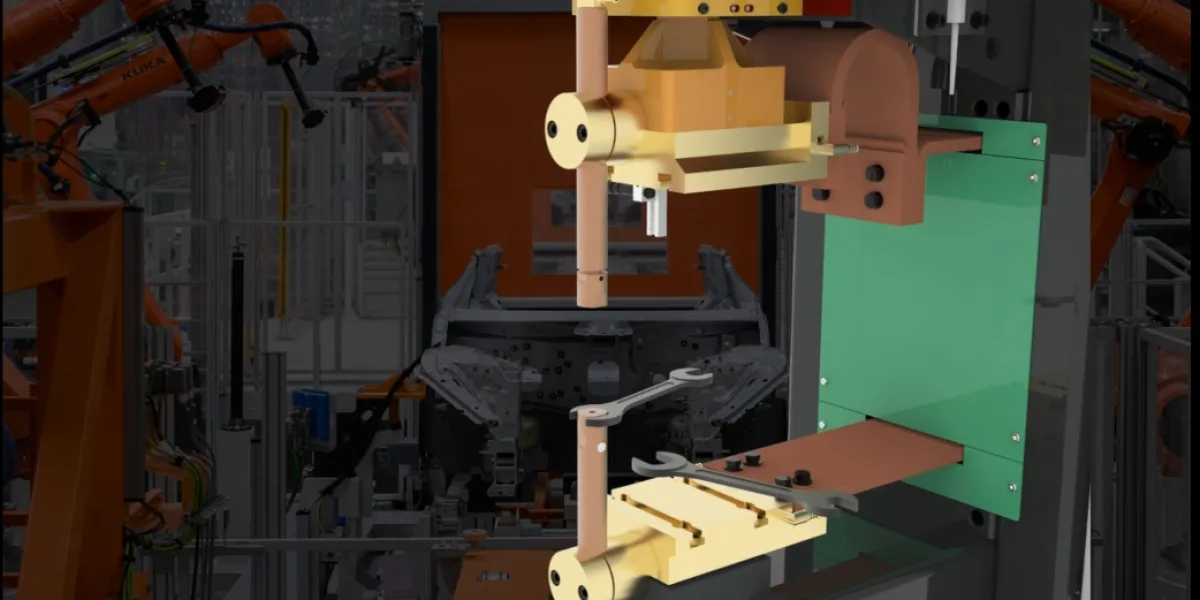
Projection welding is a highly effective resistance welding process for manufacturers that need strong, repeatable, and precisely controlled metal connections. Heron-Welder provides advanced projection welding solutions designed to address demanding industrial applications across automotive, electrical, appliance, and general manufacturing sectors. By combining engineering expertise with modern welding technology, Heron-Welder helps businesses improve production consistency, efficiency, and overall joining quality.
Unlike conventional spot welding, this process uses specially formed projections to concentrate welding energy at predetermined points. This makes it particularly valuable for applications involving nuts, studs, brackets, fasteners, and components requiring multiple controlled weld points. Heron-Welder develops solutions around these specific production requirements, helping manufacturers achieve dependable results.
Understanding Projection Welding
Projection welding uses raised areas, or projections, formed on one of the workpieces to concentrate electrical resistance and heat during the welding cycle. When pressure and electrical current are applied, the projections generate localized heat and collapse to form the welded connection.
A properly configured projection welding system allows manufacturers to control essential parameters such as welding current, electrode force, weld time, and component positioning. Consistent control of these factors is essential for producing uniform joints throughout repeated production cycles.
Heron-Welder focuses on providing resistance welding technology capable of meeting these requirements. Its application-oriented approach helps manufacturers select suitable equipment configurations according to their materials, component designs, production volume, and desired manufacturing performance.
Addressing Common Welding Challenges
Manufacturers can encounter several challenges when producing projection-welded components. Variations in material thickness, projection dimensions, component positioning, welding force, and electrical conditions can affect joint quality and process stability.
Heron-Welder addresses these challenges through carefully engineered welding solutions and controlled process parameters. The company's expertise helps manufacturers evaluate the specific characteristics of their applications and develop appropriate welding configurations.
For demanding production environments, a stable projection welding process can reduce inconsistencies and support more predictable manufacturing results. Proper electrode selection, welding force, current control, and cooling can all contribute to improved process reliability.
Solutions for Automotive Manufacturing
The automotive industry relies heavily on resistance welding for producing body structures, brackets, fasteners, and other components. Projection welding is particularly useful when manufacturers need to attach nuts, studs, or components with defined welding points.
Heron-Welder provides automotive-focused welding solutions designed to support high-volume manufacturing. Its equipment can be configured according to component geometry, material properties, weld locations, production cycle requirements, and automation objectives.
By implementing an appropriately engineered projection welding system, automotive manufacturers can improve repeatability while maintaining efficient production cycles. This can help reduce unnecessary rework and support consistent assembly quality across large production volumes.
Improving Production Efficiency
Manufacturing efficiency depends on reliable equipment, repeatable processes, and optimized production cycles. Projection welding can provide fast joining operations while reducing the need for additional mechanical fastening steps in suitable applications.
Heron-Welder's welding technologies are designed to support efficient industrial production. Automated and semi-automated configurations can help reduce repetitive manual operations and improve consistency in component positioning.
A well-integrated projection welding system can become an important part of an automated production line. By combining controlled welding with automated handling and positioning, manufacturers can establish standardized workflows that support higher throughput and predictable production performance.
Consistent Quality and Process Control
Quality control is a fundamental requirement for manufacturers producing components at scale. Inconsistent welding conditions can result in variations in joint strength, appearance, or overall assembly performance.
Heron-Welder emphasizes precise process control to help manufacturers achieve repeatable welding results. Welding current, pressure, timing, electrode condition, and component positioning can all be managed to support stable production conditions.
Manufacturers selecting projection welding equipment should consider the complete application rather than focusing on machine capacity alone. Material combinations, projection design, component dimensions, required weld force, cooling requirements, and automation compatibility can all influence system performance.
Heron-Welder's engineering experience helps businesses evaluate these factors and develop solutions aligned with their specific production objectives.
Supporting Nuts, Studs, and Specialized Components
Projection welding is especially valuable for attaching nuts, studs, and other components that require reliable and repeatable connection points. Concentrating welding energy at defined projections allows manufacturers to create multiple joints efficiently when the component design is suitable.
Heron-Welder provides specialized resistance welding technology for these demanding applications. Its solutions are designed to support accurate positioning and controlled welding conditions, helping manufacturers achieve dependable results throughout production.
For businesses producing large quantities of components with repeated attachment points, this technology can help simplify assembly and improve production consistency.
Why Choose Heron-Welder?
Heron-Welder is a professional welding technology provider with extensive experience in resistance welding and industrial manufacturing applications. Its focus on application-specific engineering enables the company to address complex joining requirements rather than relying solely on standard equipment configurations.
Choosing the right projection welding equipment requires an understanding of materials, component design, production volume, welding specifications, and automation requirements. Heron-Welder takes these factors into account when developing solutions for individual manufacturing applications.
The company's commitment to engineering quality, process stability, and practical production performance makes Heron-Welder a strong partner for businesses seeking to improve their welding capabilities.
Build a More Reliable Welding Process
Modern manufacturers need joining technology that combines precision, repeatability, and efficiency. Projection welding provides an effective solution for suitable applications involving nuts, studs, brackets, fasteners, and other specialized components.
Heron-Welder combines advanced resistance welding technology with application-focused engineering to help manufacturers overcome common production challenges. Its solutions are designed to support consistent weld quality, efficient production cycles, and integration with modern automated manufacturing systems.
For automotive, electrical, appliance, and industrial manufacturers seeking to optimize their joining operations, Heron-Welder offers professional solutions built around real production requirements. With carefully selected equipment, controlled welding parameters, and an optimized process, businesses can improve manufacturing consistency, increase efficiency, and establish a stronger foundation for long-term production success.


