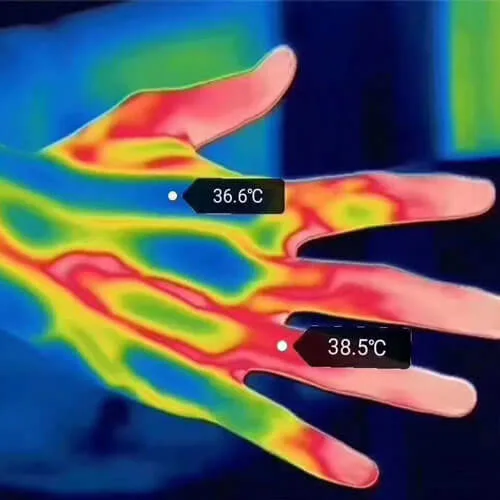
Infrared Temperature Sensors: Non-Contact Thermal Sensing "Insightful Eyes" Breaking Through Contact Limitations
Temperature is the most important fundamental physical parameter in industrial production, equipment maintenance, and safety monitoring. Traditional contact-type temperature sensing elements such as PT100 and thermocouples must be in close contact with the object being measured. This often proves ineffective when dealing with high-speed moving workpieces, high-temperature molten objects, high-voltage electrical equipment, or dangerous conditions that are difficult to access. Infrared temperature sensors measure temperature by capturing the infrared heat energy radiated by an object, eliminating the need for physical contact. With millisecond-level response speeds, they upgrade temperature measurement from "contact contact" to "remote sensing," becoming key sensing hardware in intelligent manufacturing, power system maintenance, metallurgical heat treatment, and equipment fault early warning.
Core Technology Principles and Mainstream Product Types
All objects above absolute zero continuously radiate infrared electromagnetic waves; the higher the object's temperature, the stronger the infrared radiation energy. Infrared temperature sensors collect infrared radiation emitted by a target object through an optical lens, focus it onto an infrared detector, convert the light radiation into a weak electrical signal, and then amplify, compensate for ambient temperature, and correct emissivity before finally calculating and outputting the object's surface temperature. The entire measurement process is non-contact with the object being measured and does not interfere with the object's temperature field.
Industrial online infrared temperature sensors on the market mainly fall into two categories: thermopile type and pyroelectric type.
Thermopile infrared temperature sensors, based on the Seebeck effect, use multiple thermocouples connected in series to form a thermopile, which receives infrared radiation to generate a thermoelectric potential. They can achieve static continuous temperature measurement, outputting a stable 4-20mA RS485 signal, suitable for 24-hour uninterrupted online monitoring. This is the most widely used type in industrial settings; however, emissivity parameters need to be set according to the material being measured, as shiny metal surfaces are prone to reflection interference, requiring parameter correction.
Pyroelectric infrared temperature sensors rely on the temperature change of a pyroelectric crystal under radiation to generate an electrical charge signal. Extremely fast response speed, suitable for capturing instantaneous temperature changes, but it only responds to temperature changes and cannot directly measure the temperature of constant objects. It is mostly used in human body sensing and rapid dynamic temperature measurement scenarios, and less commonly in continuous online industrial monitoring.
Mature industrial-grade infrared temperature transmitters mostly use stainless steel protective housings with protection levels of IP65 and above; they support adjustable emissivity and integrate laser aiming for positioning assistance; they output standard ModBus-RTU and 4-20mA analog signals, which can be directly connected to PLCs, industrial control computers, and IoT cloud platforms; some models are equipped with an air purge protection window to prevent lens contamination by smoke and dust in dusty or smoky production environments, ensuring long-term measurement stability.
Multi-industry applications: Solving the problems that contact temperature measurement cannot solve
The value of infrared temperature sensors is not just reading a set of temperature numbers, but solving the pain points of temperature measurement under special working conditions, serving process control and safety early warning.
Metallurgical heat treatment and intelligent manufacturing production lines: In steel rolling, forging, and baking production lines, workpieces move at high speeds, making it impossible to install contact probes. Infrared sensors collect workpiece surface temperature remotely and provide real-time feedback to the temperature control system, adjusting heating power to ensure heat treatment process quality and improve finished product yield.
Power Equipment Safety Maintenance: For live equipment such as switchgear busbars, high-voltage connectors, and transformers, direct contact temperature measurement is not possible. Infrared temperature sensors are fixedly installed at key locations, monitoring temperature rise 24/7. Automatic alarms are triggered when temperatures exceed limits, identifying potential overheating hazards early, preventing electrical fires, and enabling unattended substation thermal hazard monitoring.
Food Processing and Rubber & Plastics Industry: In baking, hot pressing, and film extrusion processes, high-temperature, high-speed moving food and plastic films are susceptible to scratches and damage from contact probes. Non-contact infrared temperature measurement does not damage the product surface and allows for closed-loop regulation of heating equipment, stabilizing product processing quality.
Energy Storage and Lithium Battery Safety Monitoring: Infrared temperature sensors monitor the temperature rise of internal cells and busbars in energy storage cabinets non-contactly, promptly detecting early thermal runaway temperature anomalies, adding a layer of awareness to energy storage fire safety.
In addition, infrared temperature sensors are widely used for online monitoring in kiln temperature measurement, rail transit brake component temperature monitoring, and photovoltaic module thermal defect detection.
https://www.renkeer.com/what-i....s-infrared-radiation